A sharp toothache can turn an ordinary evening into a frantic search for a dentist near me. You may be wondering whether you need a filling, a root canal, a crown, or something more urgent. That uncertainty is understandable, especially when dental terms sound like separate, competing choices.
For patients looking for a dentist in Chattanooga, TN or dentist in Cleveland, TN, the practical answer is that these treatments usually form a sequence of care. A filling repairs limited decay, a root canal treats infection inside the tooth, and a crown protects a tooth that has lost too much strength for a filling alone. The right plan depends on what remains healthy, how well the tooth can be sealed, and how much force it must withstand.
Understanding Your Tooth Restoration Options in Chattanooga and Cleveland
A patient may arrive after several nights of interrupted sleep, holding a cold drink against one side of the mouth because heat makes the pain worse. Another may have no severe pain at all, but a dental x-ray reveals decay beneath an old filling. Both patients may search for “root canal vs filling vs crown,” yet their treatment needs could be completely different.
At Winn Smiles, patients in Cleveland, TN, Chattanooga, TN, and nearby communities can receive an evaluation focused on preserving natural tooth structure whenever possible. The first visit isn't about choosing the most extensive treatment automatically. It's about finding out whether decay is limited, whether the pulp is infected, and whether the remaining tooth can withstand normal chewing.
A filling, root canal, and crown don't perform the same job. The diagnosis determines which part of the tooth needs attention.
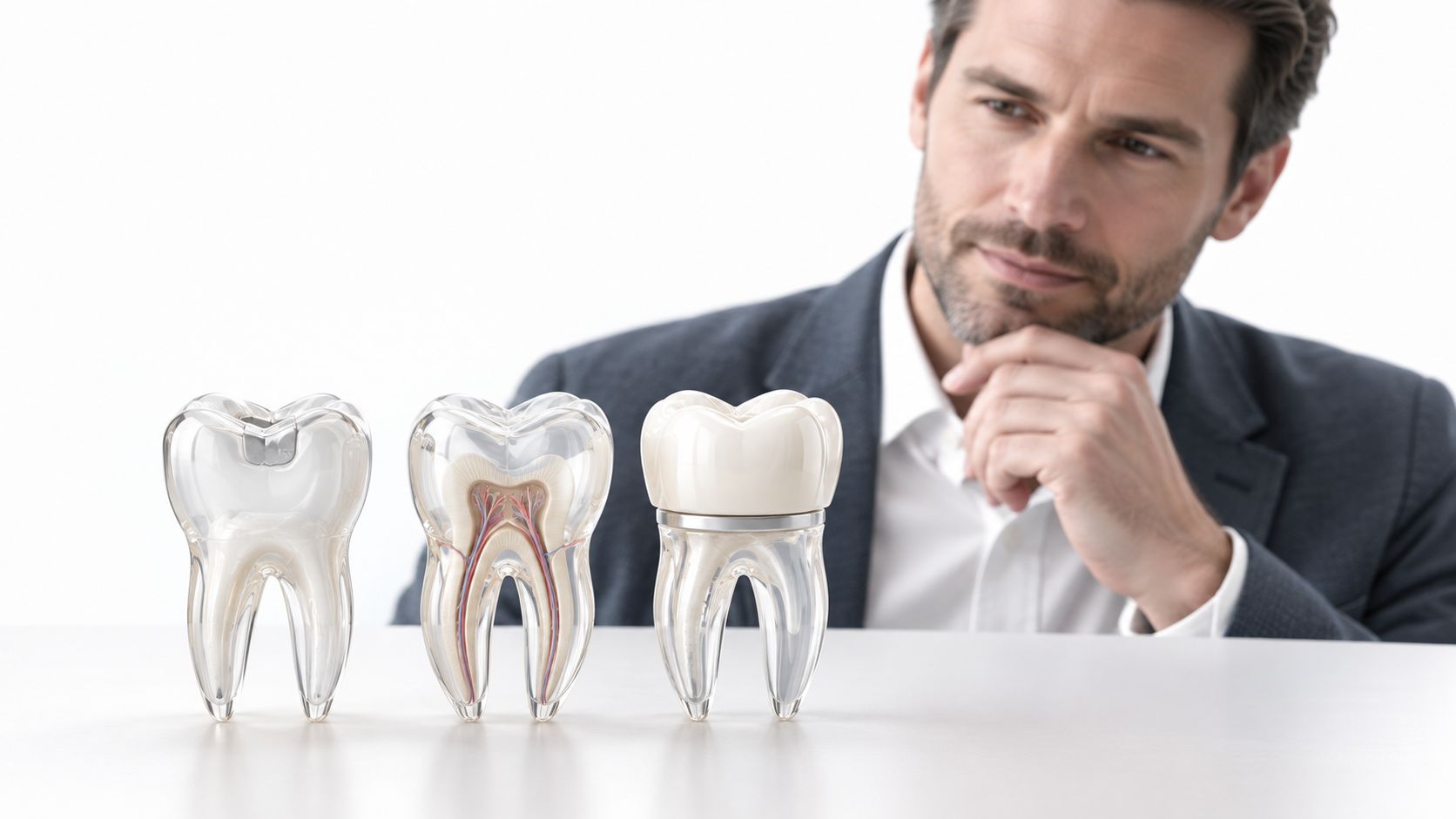
A filling replaces tooth structure lost to decay. A root canal removes infected or inflamed tissue from inside the tooth and seals the canals. A crown covers and protects the remaining tooth when it needs greater structural support. One tooth may need more than one of these treatments, such as a root canal followed by a filling and crown.
That distinction matters for anxious patients. A recommendation for a root canal doesn't mean the tooth is being abandoned. Root canal treatment is designed to remove infection while preserving the natural tooth. A crown doesn't mean the nerve is infected. It may be needed because the tooth is cracked, weakened, or missing too much structure to remain reliable with a direct filling.
Restorative dentistry works best when treatment matches the actual condition of the tooth. A new patient exam, dental x-rays, and a careful discussion of symptoms help identify the safest conservative option. If pain is severe, swelling is present, or a tooth has broken, contact an emergency dentist promptly rather than waiting for the problem to settle on its own.
Decoding the Damage to Determine the Right Treatment
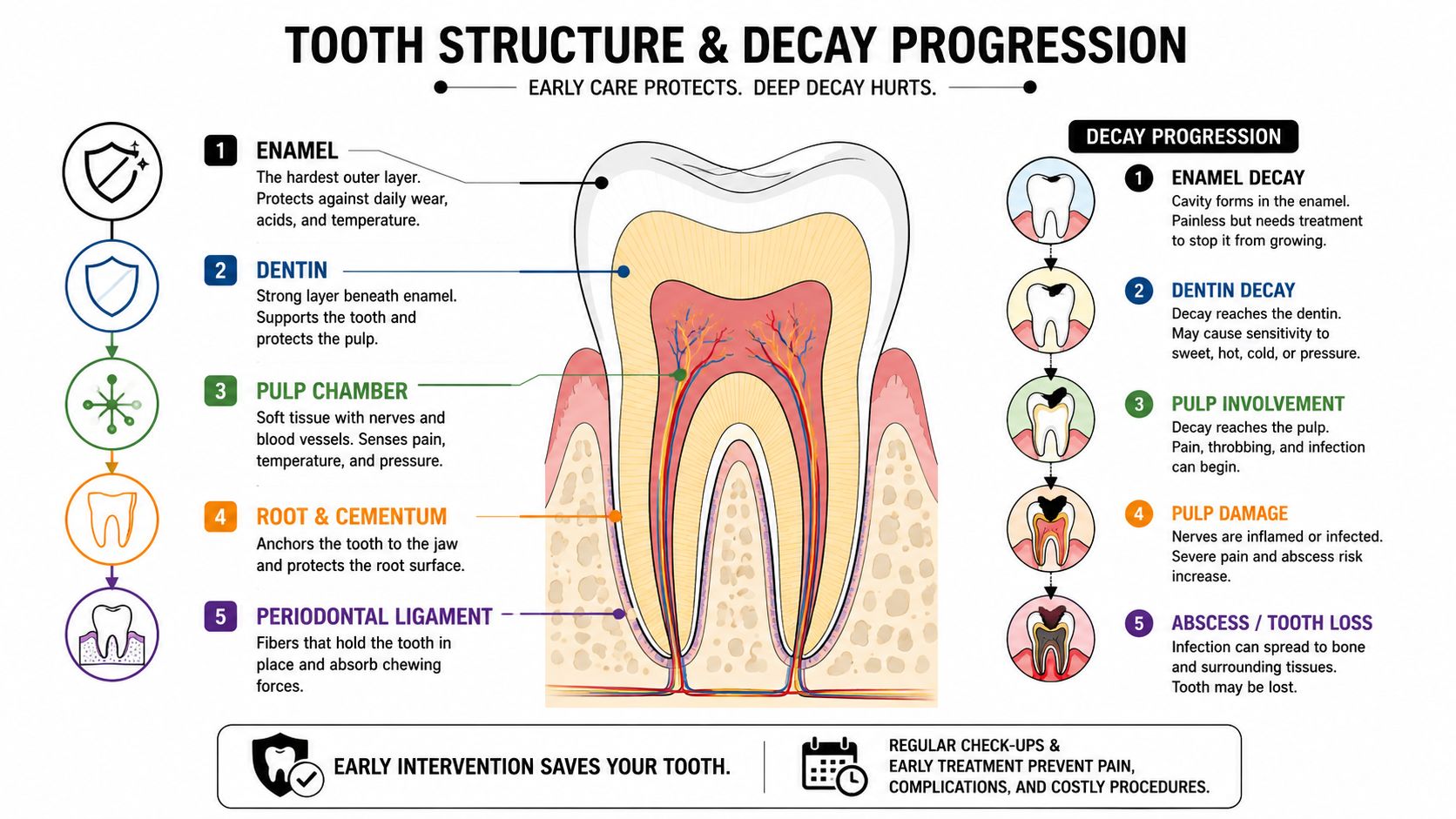
A tooth has several layers, and decay becomes more serious as it moves inward. Enamel forms the hard outer shell. Beneath it, dentin is more porous and can transmit sensitivity. At the center is the pulp, also called the inner chamber, which contains nerves and blood vessels.
The depth of damage guides the treatment.
When a filling can be enough
If decay is limited to the outer tooth structure and the pulp remains healthy, a dentist can remove the damaged area and place a filling. This is generally the most conservative repair because it preserves more natural tooth structure. Mild sensitivity, a visible area of decay, or food trapping can occur before the damage reaches the pulp, but symptoms alone can't confirm how deep the cavity is.
A filling restores the missing portion of the tooth and creates a seal against bacteria. It won't treat an infected pulp, and it can't reliably reinforce a tooth that has already lost extensive structure.
When a root canal becomes necessary
Once bacteria reach the pulp, the tooth may develop inflammation or infection that a regular filling can't resolve. Penn Dental explains that diseased pulp is removed and replaced with a filling, with a crown sometimes placed afterward to protect the tooth. Persistent pain, lingering temperature sensitivity, pain with chewing, swelling, or a gum abscess can signal a problem that needs prompt evaluation.
When the tooth needs structural protection
A crown becomes relevant when the tooth is too weakened, cracked, or extensively restored for a filling to protect it during chewing. A crown covers the visible portion of the tooth and helps hold the remaining structure together. Root-filled back teeth often need this additional protection because chewing forces are substantial and the access opening removes some tooth structure.
Grinding can also contribute to cracks and wear that complicate restorative decisions. Patients who clench or grind may benefit from discussing bite protection and related gum concerns, including this resource on grinding teeth and gum recession.
The same symptom can come from different causes, so diagnosis shouldn't rely on pain intensity alone. Dental x-rays, clinical testing, and an assessment of the remaining enamel and dentin give the dentist a clearer picture of whether a filling, root canal, crown, or another treatment is appropriate.
Comparing Fillings, Root Canals, and Crowns Side by Side
The simplest way to understand the difference is to identify what each treatment is designed to accomplish. A filling repairs a defect, a root canal controls infection, and a crown protects weakened structure.
| Treatment | Primary Purpose | Invasiveness | Structural Impact |
|---|---|---|---|
| Filling | Replace tooth structure lost to limited decay | Least invasive of the three | Preserves much of the natural tooth |
| Root canal | Remove infected pulp, clean the canals, and seal the inside | More involved internal treatment | Preserves the natural tooth but leaves it needing a durable coronal seal |
| Crown | Cover and protect a weakened or extensively damaged tooth | Requires shaping the tooth for coverage | Adds external protection and restores chewing form |
A filling usually involves numbing the tooth, removing decay, cleaning the area, and placing restorative material. The dentist then checks the bite so the repaired tooth doesn't receive excessive contact. For a limited cavity, this may be all that's required.
A root canal addresses a different problem. The infected pulp is removed, the inside of the tooth is cleaned and shaped, and the canal space is filled and sealed to help prevent reinfection. The NHS explanation of root canal treatment describes this clean, fill, and seal process and notes that a crown may be needed afterward when the tooth has been badly infected.
A crown is fabricated to fit over the prepared tooth. It restores the outside shape, protects remaining walls, and helps the tooth function in the bite. It doesn't remove infection from inside the pulp, so placing a crown over an infected tooth without addressing the infection would not solve the underlying problem.
Practical recovery differences
Patients may experience temporary tenderness after any restorative procedure, especially when the tooth has been inflamed before treatment. A root canal and crown generally involve more appointments or treatment steps than a small filling, although same-day crown technology may streamline selected cases.
Patients should follow instructions about chewing while a temporary restoration is present. They should also continue careful brushing and flossing around the treated tooth, because the gum line and the quality of the seal affect long-term performance. For more detail about fillings and related choices, see Winn Smiles' cavity treatment options.
The Hidden Factor of the Coronal Seal and Conservative Alternatives
A crown isn't automatically the right answer after every root canal. The quality and timing of the coronal seal, the restoration that closes the access into the tooth, can be just as important as the material used to cover the tooth.
A follow-up study found that the quality of the coronal restoration was significantly associated with apical periodontitis, while the quality of the root filling itself wasn't significant in that analysis. In the same national dataset, root-canal-treated teeth that received a filling soon after treatment had a median survival of 20.1 years, compared with 11.4 years for teeth restored with only a crown, 11.2 years for teeth restored with only a filling, and 6.5 years when no definitive restoration followed the root canal (study details).
These figures don't mean a filling is always better than a crown. They show why a dentist must evaluate the entire restoration sequence. A well-sealed direct restoration may be appropriate for a tooth with substantial remaining structure, while a crown may be necessary when the tooth walls are thin or the bite creates a high fracture risk.
Conservative options for selected teeth
Modern restorative dentistry also includes alternatives such as endocrowns. An endocrown uses the internal space and remaining tooth structure to retain a bonded restoration, potentially avoiding some of the additional tooth reduction associated with a conventional post-and-core crown. It isn't suitable for every tooth, but recent reviews identify it as a conservative option for selected teeth with extensive structural loss.
The key question isn't just, “Which treatment lasts longest?” It's, “Which restoration creates a reliable seal while preserving enough healthy structure to handle this patient's bite?” That answer can vary between a front tooth and a molar, between a lightly loaded tooth and one exposed to grinding, and between a tooth with strong remaining walls and one with a deep crack.
A thoughtful consultation should cover those trade-offs rather than present a crown as an automatic upgrade.
Patients should also ask how quickly the final restoration can be placed, how the temporary seal will be protected, and what signs would require a follow-up visit. Those details often determine whether a technically successful root canal remains comfortable and functional over time.
What to Expect During Your Restorative Dental Visit
A restorative visit should begin with communication, not pressure. The dentist will review your symptoms, examine the tooth, and use dental x-rays or other diagnostic tools to evaluate decay, infection, cracks, bone support, and the amount of healthy structure left.
At Winn Smiles, patients in Chattanooga and Cleveland can discuss comfort preferences before treatment starts. The practice offers a comfort menu and sedation options matched to each patient, which can be especially helpful for patients who have avoided dental care because of anxiety. A friendly team can explain each step, answer questions, and agree on signals for pausing during treatment.
A clear clinical sequence
Your appointment may include:
- Diagnosis: The dentist identifies whether the pulp is healthy, inflamed, or infected and checks how much tooth structure remains.
- Treatment planning: You'll discuss whether a filling, root canal, crown, endocrown, or another option fits the tooth.
- Comfort preparation: Local anesthesia and available sedation choices are reviewed before the procedure begins.
- Restoration: The tooth is repaired, internally treated, or prepared for coverage according to the diagnosis.
- Bite and seal check: The dentist verifies that the restoration fits comfortably and closes the tooth properly.
Laser dentistry may be used for selected procedures when it can make treatment more precise or gentler. Same-day crown technology can also restore function and appearance in one visit for appropriate cases, reducing the time a patient spends with a temporary restoration.
A crown is often used after root canal treatment because the tooth may be structurally weaker. Cleveland Clinic describes the process as removing the infected pulp, filling the canal, sealing the tooth with a temporary filling, and placing a permanent crown later to protect the tooth and restore the bite (root canal treatment information).
You can review practical details before your appointment through Winn Smiles' guide to what to expect during a root canal. If you're experiencing swelling, severe pain, or a broken tooth, ask about emergency dental services rather than waiting for a routine cleaning and exam.
Long-Term Survival and Restoration Longevity Data
Patients understandably want to know whether treatment will protect a tooth for the long term. Survival depends on the original damage, remaining tooth structure, the quality of the root canal and coronal seal, the restoration chosen, oral hygiene, bite forces, and whether the patient receives timely follow-up care.
A large national-database study found a median tooth survival time of 11.1 years after root canal therapy, with 26.1% of root canals estimated to survive beyond 20 years (national-database study). The same study found that teeth receiving a root canal followed by both a filling and a crown lasted about 20 years, compared with about 11 years when the root canal was followed by only a filling or only a crown, and about 6.5 years when no restorative work followed the root canal.
These results support a practical principle: root canal therapy doesn't finish the restoration process. The tooth needs a dependable seal and enough structural protection for its location and bite. Leaving a treated tooth without definitive restoration can expose it to leakage, fracture, and additional treatment.
What posterior tooth data tells us
For root-filled posterior teeth, a recent meta-analysis reported a 92% survival rate over 4 to 7 years and an 87% survival rate over 8 to 20 years (posterior tooth survival meta-analysis). The same evidence indicates that restoration choice affects retention, with crowns repeatedly associated with higher retention than direct restorations.
Historical data from England and Wales also found about 81% ± 12% long-term survival for root-filled teeth covered with crowns, compared with about 63% ± 15% for root-filled teeth without crown coverage (General Dental Services analysis). For anterior teeth, crowns had 42% survival without re-intervention at 10 years, compared with 35% for plastic restorations. For premolars, the corresponding figures were 57% with crowns and 34% with plastic restorations.
Those figures are population benchmarks, not a promise for an individual tooth. Material selection, tooth position, crack risk, and the quality of the final seal all matter. Patients considering ceramic coverage can also review ceramic crown preparation guidelines as background, then discuss which design is appropriate with their dentist.
Planning Your Smile Restoration with Winn Smiles
The best decision in a root canal vs filling vs crown discussion starts with a complete diagnosis and an honest conversation about priorities. A tooth with limited decay may need only a filling. A tooth with infected pulp may need root canal treatment followed by a carefully sealed restoration. A cracked or structurally compromised tooth may require a crown, while selected cases may suit a more conservative bonded approach.
The American Association of Endodontists recommends placing a permanent coronal restoration as soon as feasible after endodontic treatment. For posterior teeth, the restoration typically has two phases, core placement followed by crown placement. If too little tooth structure remains to retain the core, a post may be needed (AAE treatment standards).
A local plan built around your tooth
Patients in Chattanooga, Cleveland, and nearby service areas can ask for:
- A full evaluation: Dental x-rays and clinical testing help establish whether the pulp, root, and remaining crown are healthy.
- Transparent cost discussions: Understanding the sequence of care makes it easier to compare immediate treatment with long-term tooth preservation.
- Comfort-focused dentistry: Sedation options and clear explanations can reduce stress for nervous patients.
- Broader treatment planning: If a tooth can't be saved, the discussion may include tooth extraction and replacement options such as dental implants.
- Related smile services: Preventive cleaning and exams, teeth whitening, cosmetic dentistry, periodontal care, and emergency dentistry can support the rest of your oral health.
Winn Smiles provides general, restorative, cosmetic, and emergency dental services, along with dental implants, full-arch implant solutions, laser dentistry, and same-day crowns. The practice also offers free consultations and second opinions for select services, giving patients another way to make an informed decision before moving forward.
Don't try to diagnose the tooth from symptoms alone. Schedule a new patient exam or consultation so a dentist can determine whether the most conservative solution is also the safest long-term solution.
If you're dealing with tooth pain or have been told you need a filling, root canal, or crown, visit Winn Smiles for a careful evaluation in Chattanooga or Cleveland. The team can discuss comfort options, explain your restoration choices, and help you schedule the care your tooth needs.