You're sitting at home in Cleveland or Chattanooga, scrolling through porcelain veneer photos and wondering whether a brighter, more even smile would finally make you feel comfortable in pictures. Maybe you have stubborn discoloration, small gaps, worn edges, or teeth that look uneven. The difficult part isn't finding a cosmetic dentist near me. It's deciding whether veneers are the right treatment for your actual teeth, health, budget, and long-term plans.
My honest answer is simple: porcelain veneers can be an excellent choice for carefully selected patients, but they shouldn't be the first answer to every cosmetic concern. Whitening, bonding, Invisalign, periodontal care, or restorative dentistry may solve your problem while preserving more natural tooth structure. A consultation with a Cleveland or Chattanooga dentist should help you compare those options, not pressure you into a smile makeover.
Why Most Patients Ask the Wrong Question First
You may love the finished veneer photos shown online. They cannot reveal whether the person had healthy enamel, stable gums, a manageable bite, or enough tooth structure for predictable bonding. They also say nothing about decay, large fillings, or nighttime grinding.
Replace “Do I want veneers?” with a sharper question:
Are my teeth healthy and structurally suitable for veneers, or would whitening, bonding, or orthodontics solve the same concern more conservatively?
Porcelain veneers usually require removing a thin layer of enamel so the ceramic can sit flush and bond securely. Enamel does not grow back. For patients in Cleveland or Chattanooga, TN, that makes veneers an irreversible restorative decision, not a temporary cosmetic accessory. Porcelain veneer preparation commonly removes about 0.3 to 0.5 mm of enamel, although the amount varies with tooth shape, the planned result, and the preparation design.
The foundation matters more than the photo
Before recommending veneers, a responsible cosmetic dentist should evaluate:
- Enamel thickness: Veneers bond most predictably when sufficient healthy enamel remains.
- Bite forces: Clenching and grinding can raise the risk of fracture or debonding.
- Gum health: Inflammation or recession can affect both appearance and veneer margins.
- Existing restorations: Large fillings or weakened teeth may call for another treatment.
- Your actual goal: Whitening, alignment, shape changes, and structural damage need different solutions.
The long-term evidence supports careful case selection. A systematic review reported estimated five-year survival of 95.7% for feldspathic porcelain veneers. Its post hoc estimate placed ten-year survival near 95.6%. The same evidence base included reports of 96% survival at 10 years and 91% at 20 years for a broader group bonded to prepared enamel. Review the clinical evidence on porcelain veneer survival in PubMed Central.
Those findings are encouraging, but veneers do not last forever and do not perform equally well for every patient. The enamel bond, bite, gum condition, and case design all affect the result. If a practice recommends your new smile before examining your teeth, gums, and bite, choose a different consultation. Start with biology and treatment alternatives, then decide whether veneers deserve a place in the plan.
What Porcelain Veneers Actually Are
Porcelain veneers are thin, custom-made ceramic shells that bond to the visible front surface of a tooth. Think of one as a carefully fitted contact lens for the front of a tooth. It can change color, shape, proportion, and the appearance of small spaces without covering the entire tooth like a crown.
The veneer itself is thin, commonly around 0.3 to 1.0 mm, and traditional preparation may remove roughly 0.3 to 0.7 mm of enamel. This clinical overview explains veneer thickness and the importance of enamel bonding. The dentist may numb the area, smooth the enamel, scan the teeth digitally or take impressions, and send detailed specifications to a dental laboratory. A ceramist then creates the porcelain to reproduce natural translucency, texture, and shade.
What happens during preparation
Preparation is similar to smoothing a natural nail before applying an acrylic tip. The dentist removes enough surface structure for the veneer to fit without looking bulky, while trying to preserve as much enamel as possible.
The usual sequence includes:
- Planning: Your dentist evaluates your smile, bite, gum position, tooth color, and desired changes.
- Numbing: Local anesthetic keeps the preparation comfortable.
- Enamel shaping: The dentist refines the front surface and, depending on the design, may involve the edge of the tooth.
- Records: Digital scans, photographs, and shade information guide the laboratory.
- Temporaries: Temporary veneers protect the prepared teeth while the final restorations are made.
- Try-in and bonding: The final veneers are checked, adjusted, and bonded when the fit and appearance are right.
Veneers usually cover the visible front surface, not the back of the tooth. The biting edge may or may not be included, depending on the design and how much support your teeth need. A systematic review found 95.5% cumulative survival at 10 years across 6,500 porcelain laminate veneers, with fracture, debonding, secondary caries, and endodontic treatment among the main failure modes. Read the systematic review on long-term porcelain laminate veneer durability.
The laboratory phase commonly takes two to three weeks, during which temporaries help protect the teeth and give you an early sense of the planned appearance. Your dentist should explain how to care for them and what foods or habits could damage them.
Are You a Good Candidate for Veneers
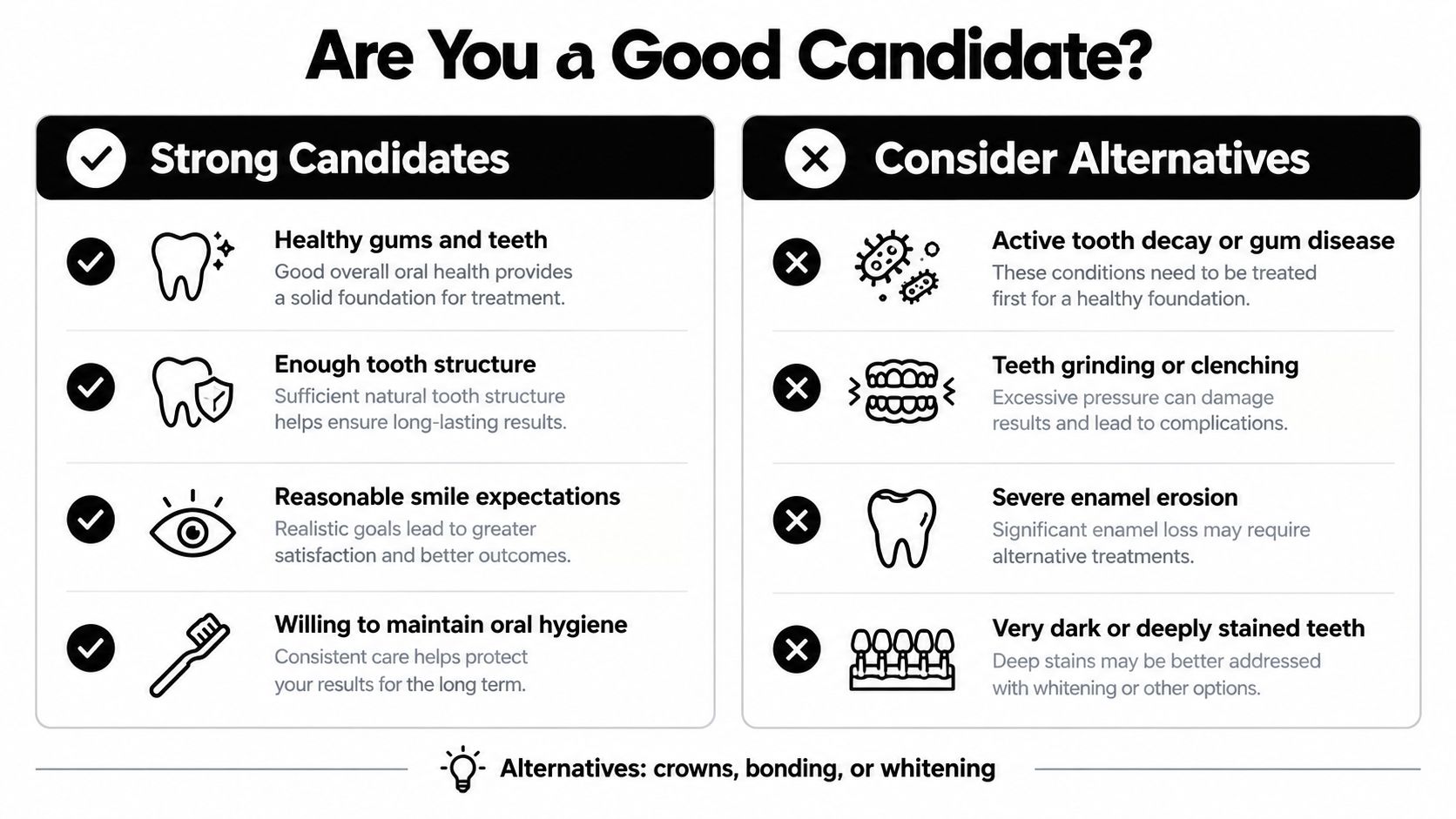
A strong candidate has a healthy foundation and a cosmetic concern that veneers can address predictably. That often includes discoloration that doesn't respond well to teeth whitening, small chips, uneven edges, minor gaps, or mild shape and proportion concerns. Veneers can also help when a patient wants several cosmetic changes coordinated at once.
The right starting point is healthy teeth and stable gums. Active decay, untreated gum disease, significant enamel erosion, large failing fillings, or severely weakened teeth should be addressed before cosmetic treatment. If a tooth has lost substantial structure, a crown may provide better protection than a veneer. If the main issue is tooth position or bite, orthodontics may be the more responsible first step.
When veneers make sense
Veneers may be worth discussing if you:
- Have healthy enamel: The long-term evidence favors veneers bonded to enamel.
- Want coordinated cosmetic changes: Several small concerns can sometimes be treated within one design.
- Have realistic expectations: Natural-looking results involve proportion, translucency, and facial balance, not the whitest possible shade.
- Can maintain the result: Your underlying teeth and gums still require daily brushing, flossing, professional cleanings, and dental exams.
- Understand permanence: Once enamel is prepared, future care will involve restorative management.
When another treatment may be wiser
Patients with untreated decay or gum disease should stabilize oral health first. Those who clench or grind need an honest bite assessment and may need protective care before considering veneers. Veneers also aren't a good substitute for correcting a substantial bite problem.
The trade-off is clear. You exchange a small amount of natural enamel for a durable ceramic surface that can improve appearance and resist many forms of staining. In return, you accept that the preparation cannot be undone and that veneers may eventually need replacement. A contemporary systematic review discusses the relationship between enamel preservation, preparation depth, and veneer survival.
If you're asking, “Should I get porcelain veneers?” start with your dental health and goals. A good cosmetic dentist will tell you when veneers aren't the answer.
How Veneers Compare to Bonding, Crowns, and Orthodontics
A chipped front tooth, uneven color, or small gap does not automatically call for veneers. The right choice depends on how much healthy enamel can remain, how strong the tooth is, and whether the concern is cosmetic or structural. For patients in Cleveland and Chattanooga, the practical recommendation is simple: compare veneers with whitening, bonding, and orthodontics before accepting irreversible preparation.
Composite bonding applies tooth-colored resin directly to the tooth. It suits a small chip or minor shape change, especially when preserving enamel and making future repair easier matter most. Whitening is less invasive when the problem is generalized tooth color. Orthodontics, including clear aligners, moves teeth and can address spacing, alignment, or bite concerns that veneers should not be used to correct.
Crowns serve a different purpose. A crown covers the entire tooth and usually requires more reduction, so dentists reserve it for teeth that are cracked, root-canaled, heavily restored, or structurally weakened. A veneer covers mainly the visible front surface and relies on the remaining tooth structure for support.
| Treatment | Best For | Enamel Removed | Lifespan | Approx. Cost Range |
|---|---|---|---|---|
| Porcelain veneers | Discoloration, chips, gaps, shape, mild cosmetic irregularity | Usually a thin layer, often about 0.3 to 0.7 mm | Long-term, often a decade or longer when properly selected and bonded | Roughly $900 to $2,500 per tooth, as discussed in Winn Smiles' comparison of dental veneers and bonding |
| Composite bonding | Small chips, minor shape changes, conservative cosmetic repair | Little to none in many cases | Shorter than porcelain and may need touch-ups | Varies by tooth and treatment complexity |
| All-ceramic crowns | Cracked, root-canaled, or structurally weakened teeth | More extensive, full-coverage preparation | Long-term restorative treatment | Varies by tooth and treatment complexity |
| Orthodontics | Tooth position, spacing, and bite concerns | Preserves enamel | Treatment result depends on retention and maintenance | Varies by case and provider |
| Whitening | Generalized surface or natural tooth discoloration | None | Requires maintenance over time | Varies by treatment type |
Use the least invasive treatment that can reliably solve the actual problem. Choose whitening for color alone, bonding for limited repairs, orthodontics for tooth position, crowns for weakened teeth, and veneers when several visible cosmetic concerns justify permanent enamel preparation.
What the Veneer Process Feels Like Step by Step
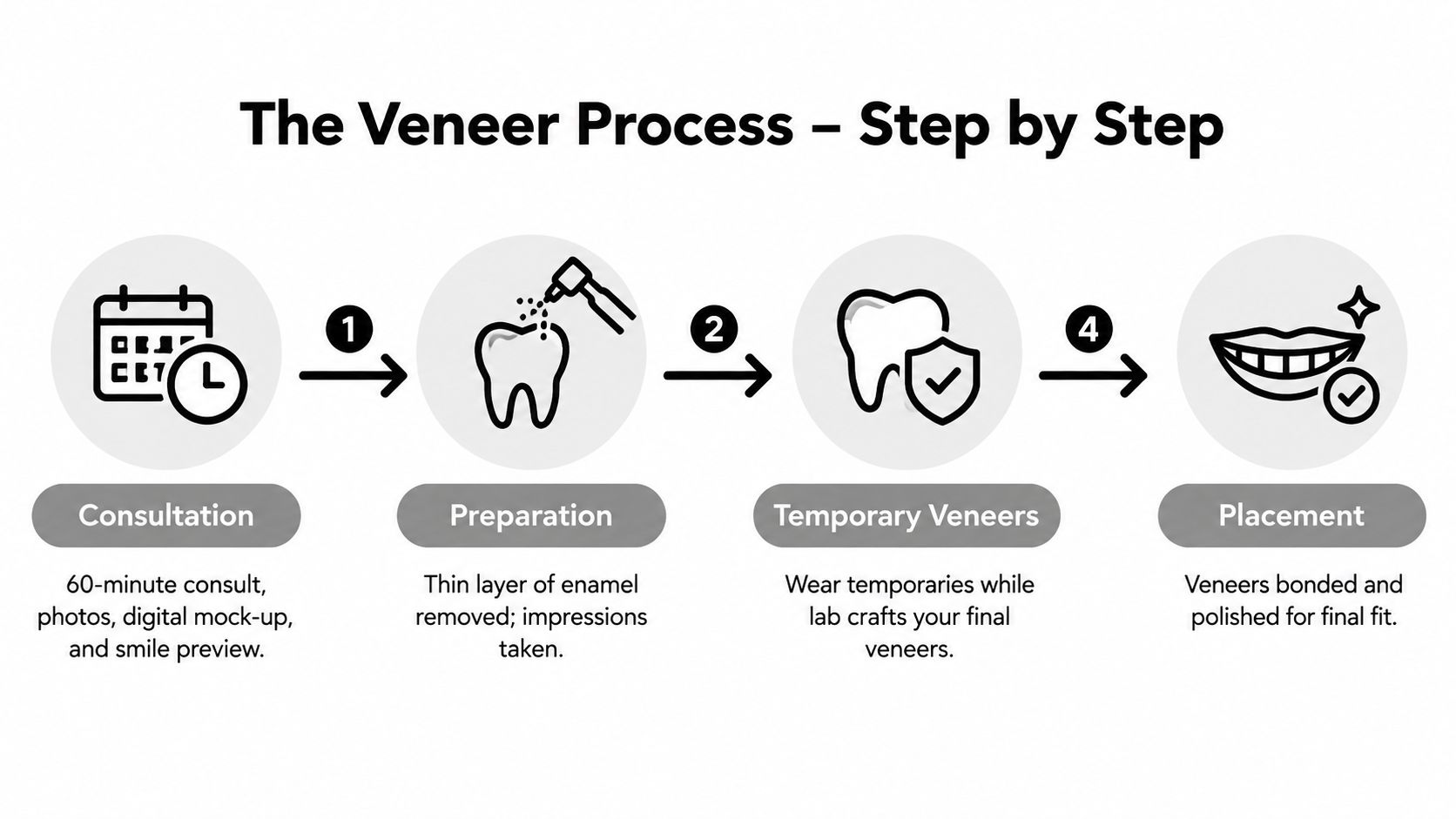
Your first appointment should feel like a careful conversation, not a sales presentation. A cosmetic consultation may take roughly 60 minutes and include photographs, digital scans, a bite evaluation, and a mock-up or smile preview. Discuss what bothers you, which teeth you want to preserve, and what would look natural on your face.
Consultation and preparation
If veneers suit your teeth and goals, the preparation visit may take about 90 minutes for a full arch. Local anesthetic keeps the procedure comfortable while the dentist conservatively reshapes the enamel, often around 0.5 mm for the planned design. This step is irreversible, so ask exactly how much enamel the proposed design requires. The clinical explanation of porcelain veneer preparation describes the thin enamel reduction required for fit and bonding.
The dentist then places temporary acrylic veneers. They should look presentable, but they are not the final result. Avoid crunchy or sticky foods that could loosen them, and contact the office if one feels loose or comes off.
The laboratory and bonding visits
During the laboratory phase, a ceramist creates the final restorations from your scans, photographs, shade information, and design plan. Feldspathic porcelain may be layered and fired to produce lifelike color and translucency instead of a flat appearance.
At the bonding appointment, the dentist tries in each veneer, checks fit and shade, evaluates your bite, and makes adjustments before final cementation. The visit may take around two hours, depending on the number of veneers and case complexity. Temporary sensitivity or minor gum tenderness is more typical afterward than significant pain.
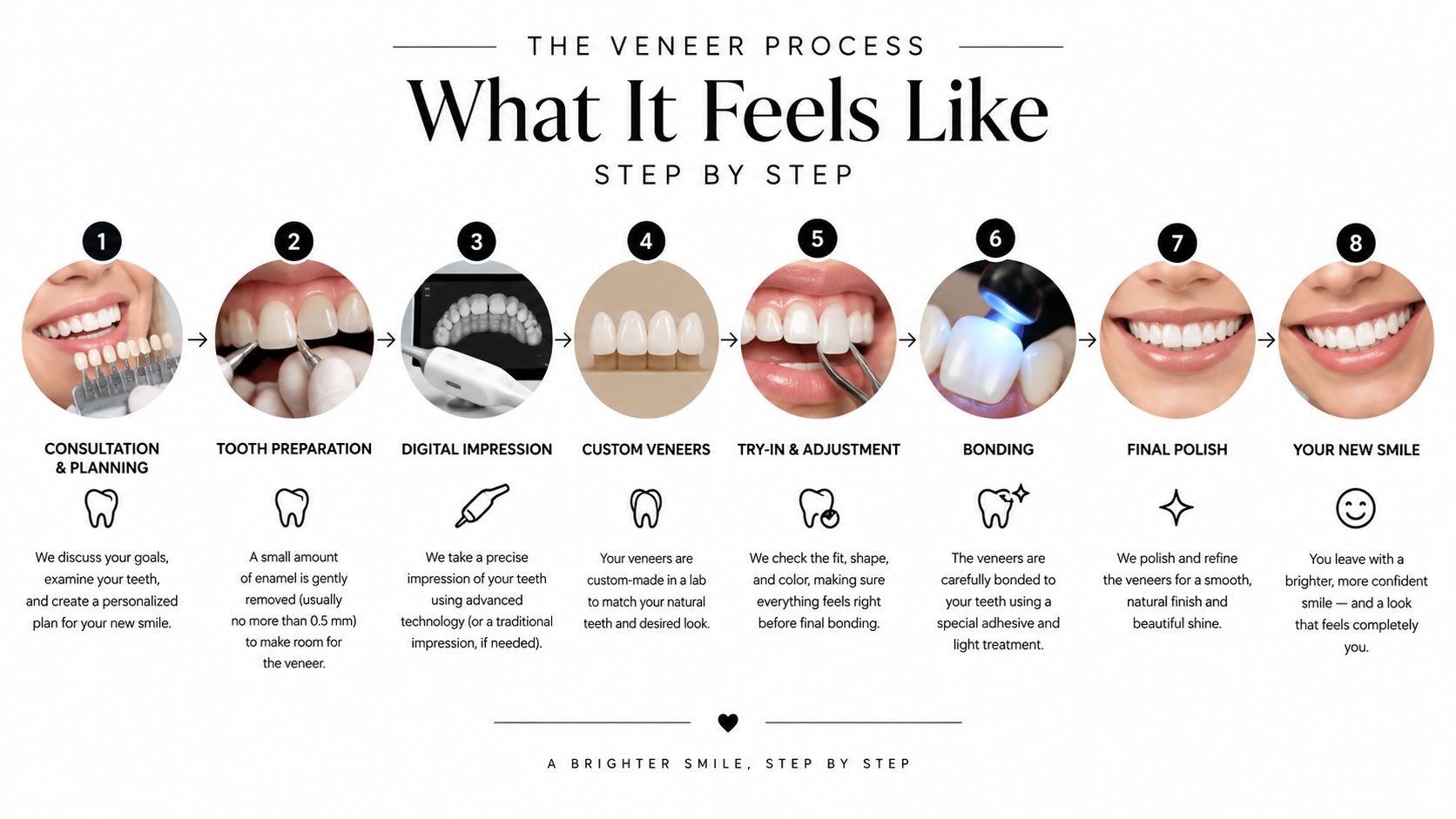
Before leaving, get written instructions for brushing, flossing, eating with temporaries, and managing sensitivity. If anxiety is a concern, tell the dental team before treatment begins so they can explain comfort measures and appropriate sedation options. In Cleveland or Chattanooga, choose a dentist who shows you the proposed design and enamel plan before any irreversible preparation starts.
Cost, Lifespan, and What Can Go Wrong
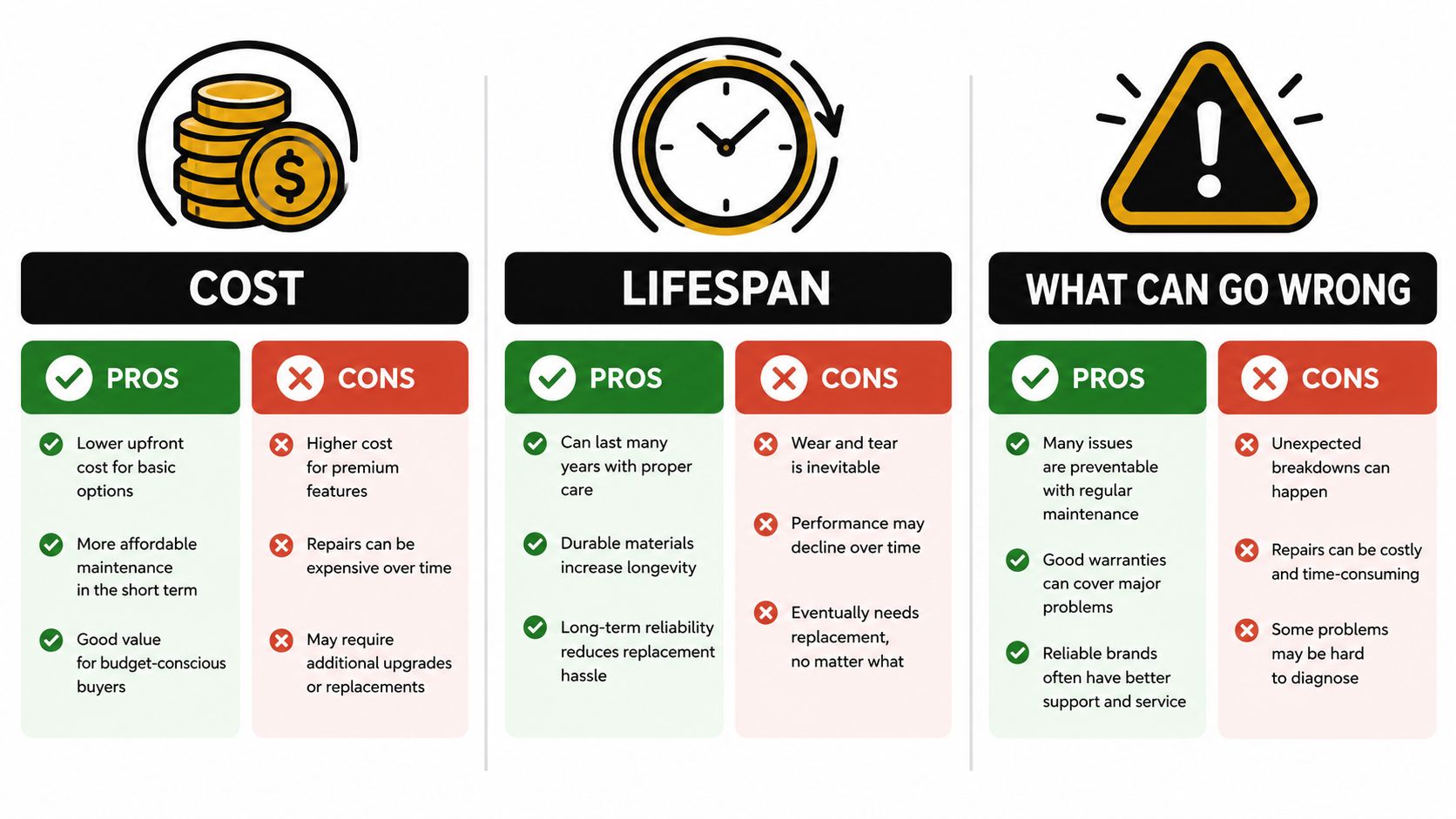
Porcelain veneers are priced per tooth, so the total depends largely on how many teeth need treatment and how much planning or preparatory care is involved. Neutral patient education sources describe a broad range of roughly $900 to $2,500 per tooth, while full-smile treatment can reach well into five figures. See the patient-focused overview of porcelain veneer costs.
That price should be evaluated alongside the permanence of preparation. A lower initial quote may not represent the full treatment if you need gum therapy, decay treatment, bite protection, replacement temporaries, or future restorative work.
Longevity is strong, but replacement belongs in the plan
Clinical evidence gives porcelain veneers a strong long-term record. The systematic review cited earlier found 95.7% cumulative survival at 5 years for feldspathic porcelain veneers and estimated that survival at 10 years may approach 95.6% when conditions are favorable. The broader literature also includes 91% survival at 20 years for veneers bonded to prepared enamel. Review the broader clinical evidence on veneer longevity and failure.
“Survival” means the restoration remains present and functional. It doesn't promise that every veneer will look untouched forever or that replacement will never be needed. Fracture is a leading failure mode, followed by debonding and color change. Secondary decay, endodontic treatment, gum changes, and bite trauma can also affect the result.
Habits and maintenance matter
Veneers don't eliminate the need for dental care. The natural tooth underneath can still decay, and the gumline still needs careful cleaning. Nail biting, chewing ice, using teeth as tools, clenching, and grinding can increase stress on the ceramic.
Replacement cost can resemble the original treatment, so think beyond the first invoice. Ask for an itemized plan that explains preparation, temporaries, laboratory fees, bonding, follow-up care, repairs, and what happens if a veneer fails. For a practical discussion of durability, read how long veneers last.
What to Expect at a Cleveland or Chattanooga Cosmetic Dentist
A good first visit in Cleveland or Chattanooga, TN should begin with listening. You'll explain whether your concern is color, shape, spacing, worn edges, or confidence in photos. The dentist should then examine your teeth and gums before discussing porcelain veneers, bonding, whitening, Invisalign, crowns, or another form of cosmetic or restorative dentistry.
Expect more than a routine cleaning and exam. A cosmetic consultation may include intraoral photography, digital impressions instead of goopy trays, a bite assessment, and a chairside preview of possible tooth shapes and shades. Some practices use digital smile design tools or temporary mock-ups so you can respond to the proposed result before anything permanent happens.
Comfort should be part of the treatment plan
Dental anxiety is common, and you shouldn't have to hide it. Ask about:
- Comfort options: Blankets, neck pillows, and noise-canceling headphones can make a long visit easier.
- Sedation choices: Nitrous oxide or oral conscious sedation may be appropriate for some anxious patients after a dentist reviews your health history.
- Clear communication: Agree on a hand signal and ask the team to explain each stage before it begins.
- Follow-up access: Local care makes post-treatment checks, bite adjustments, and repairs more convenient.
A Cleveland or Chattanooga practice may work with an on-site or partner ceramist for custom shade selection and design communication. That can be especially helpful when you want a result that looks bright but still fits your complexion, age, facial features, and existing teeth.
Local accountability matters, too. You want a dental office that can see you promptly if a temporary loosens, a veneer chips, or your bite feels uncomfortable. If you're researching how dental practices build patient trust online, how Magnitude Marketing helped Bright Smiles offers useful context about presenting dental services clearly to local patients.
Winn Smiles serves Cleveland and Chattanooga with cosmetic consultations, veneers, teeth whitening, Invisalign, general dental care, restorative dentistry, emergency dental services, and dental implants. The right office for you should explain costs, alternatives, maintenance, and limitations without treating every concern as a reason for veneers.
Your Next Step Toward a Confident Smile
Don't book veneers because an online photo made you feel behind. Book a consultation because you want a careful answer about your teeth.
Choose a Cleveland or Chattanooga TN cosmetic dentist who can show a consistent before-and-after gallery, offer a digital smile preview, and explain when whitening, bonding, orthodontics, or crowns would be more appropriate. You should receive a treatment plan that addresses oral health first and separates necessary care from optional cosmetic changes.
Bring three things to the appointment:
- Your concerns: Write down exactly what bothers you, such as dark color, uneven edges, gaps, or one chipped tooth.
- Reference photos: Bring smiles you admire, but be prepared to discuss what you like about them, including shade, length, shape, or softness.
- Direct questions: Ask how much enamel will be removed, how your bite affects the plan, how long the veneers may last, how they'll be maintained, and what replacement could involve.
Veneers aren't urgent treatment for most cosmetic concerns. Taking time to consider a second opinion or sleep on a proposed plan is reasonable. A trustworthy dentist won't be offended if you need time, and they'll be willing to say veneers aren't the best answer.
If you're also searching for a dentist near me, an emergency dentist, tooth extraction, or dental implants near me, mention those needs during your visit. An evaluation can identify decay, gum concerns, missing teeth, bite problems, or other issues that should be addressed before cosmetic dentistry.
Your confident smile should begin with an informed decision. Schedule a no-pressure cosmetic consultation in Cleveland or Chattanooga, bring your questions, and let the dentist help you decide whether porcelain veneers fit your biology, goals, and budget.
Schedule a cosmetic consultation with Winn Smiles to discuss porcelain veneers, whitening, bonding, Invisalign, or restorative alternatives in Cleveland or Chattanooga. The team can evaluate your smile, explain preparation and long-term maintenance, and help you choose a treatment plan that fits your needs.