If you're searching for a dentist near me in Cleveland, TN, or comparing a cosmetic dentist near me in Chattanooga, TN, you may be looking at two very different treatments that happen to appear in the same smile makeover conversation. Veneers can improve a tooth that's still present. Dental implants can replace a tooth that's gone. Choosing well means looking beyond the first appointment and asking what your smile, gums, bite, and maintenance routine will need over the years.
Two Patients, Two Different Decisions
A 38-year-old comes in after chipping a front tooth during a basketball game. The root is still healthy, the tooth is stable, and the concern is obvious when he smiles. He wants the tooth to look natural again, but he doesn't want an unnecessary extraction or surgery. He's worried about making a permanent choice quickly and wonders whether a veneer will hold up to normal eating and daily life.
A 55-year-old has a different problem. A molar was lost after years of decay, and the gap now affects chewing on that side. The question isn't how to improve the shape or color of an existing tooth. The question is how to replace the missing root and tooth without placing unnecessary strain on nearby teeth. He's thinking about healing, maintenance, and what happens if the implant develops a problem later.
These patients shouldn't receive the same recommendation. The first patient may be in veneer territory, provided the tooth has enough healthy enamel and no active decay or disease. The second may be a strong dental implant candidate, subject to an examination of bone, gums, bite forces, and overall health.
Practical rule: If there's a healthy tooth under the cosmetic concern, preserve it whenever a conservative restoration can solve the problem. If the tooth is missing or cannot be predictably rebuilt, replacement becomes the priority.
The decision also depends on your expectations. One patient may prioritize a faster cosmetic result. Another may accept a longer restorative process to regain chewing function. A consultation with a dentist in Cleveland, TN, or a trusted dental office serving Chattanooga should address both the immediate appearance and the future maintenance plan.
What Veneers and Implants Actually Do
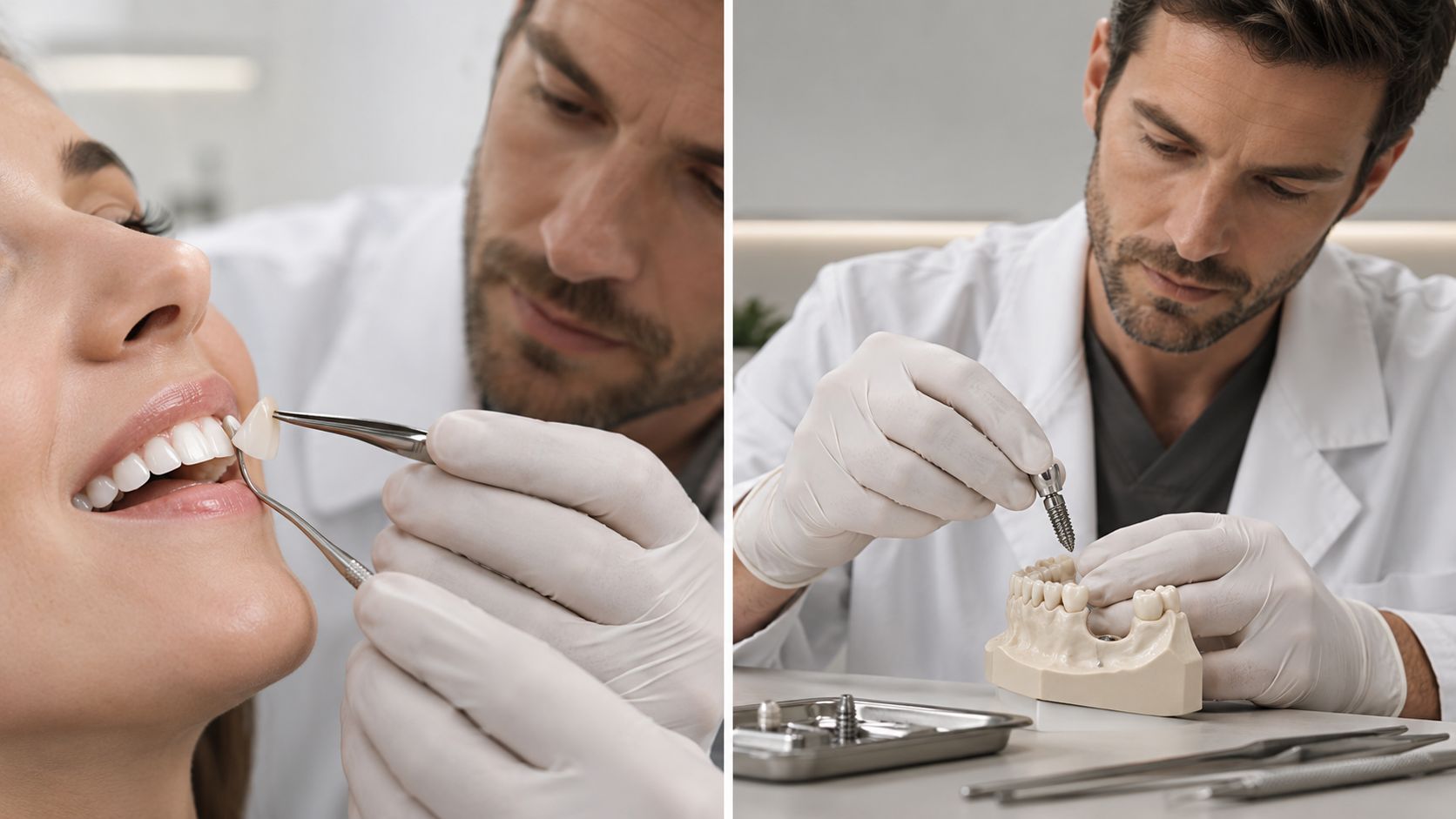
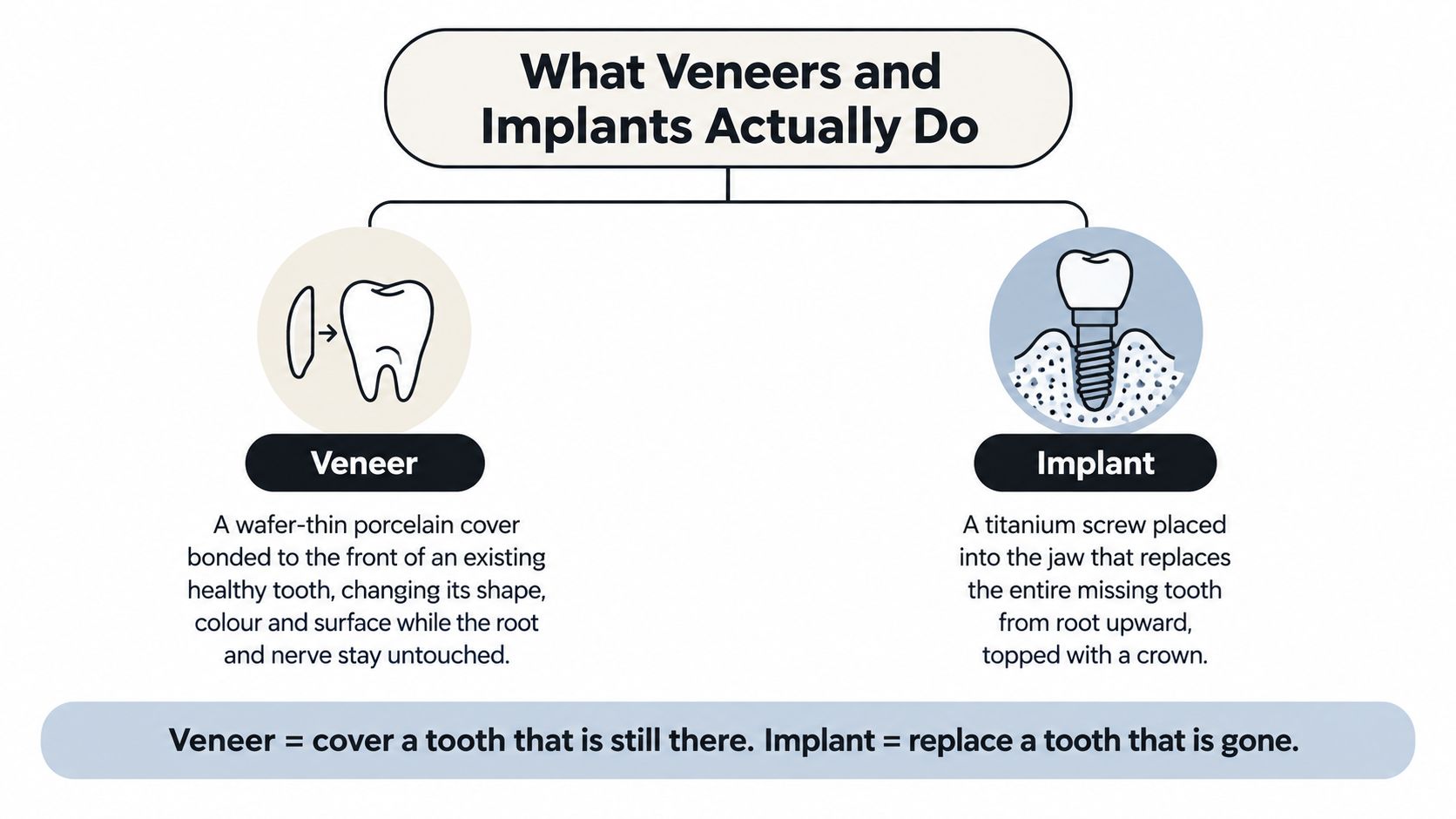
A veneer is a thin porcelain or laminate shell bonded to the front of an existing tooth. It can alter the tooth's visible color, shape, size, and surface character. The natural root remains underneath, and the treatment is aimed at improving the tooth's appearance rather than replacing its foundation.
Veneers are commonly considered for discoloration that doesn't respond to teeth whitening, small chips, minor shape irregularities, and limited cosmetic concerns. They don't replace missing teeth, treat active decay, or make gum disease disappear. A dentist must first determine whether the tooth is healthy enough to support cosmetic dentistry.
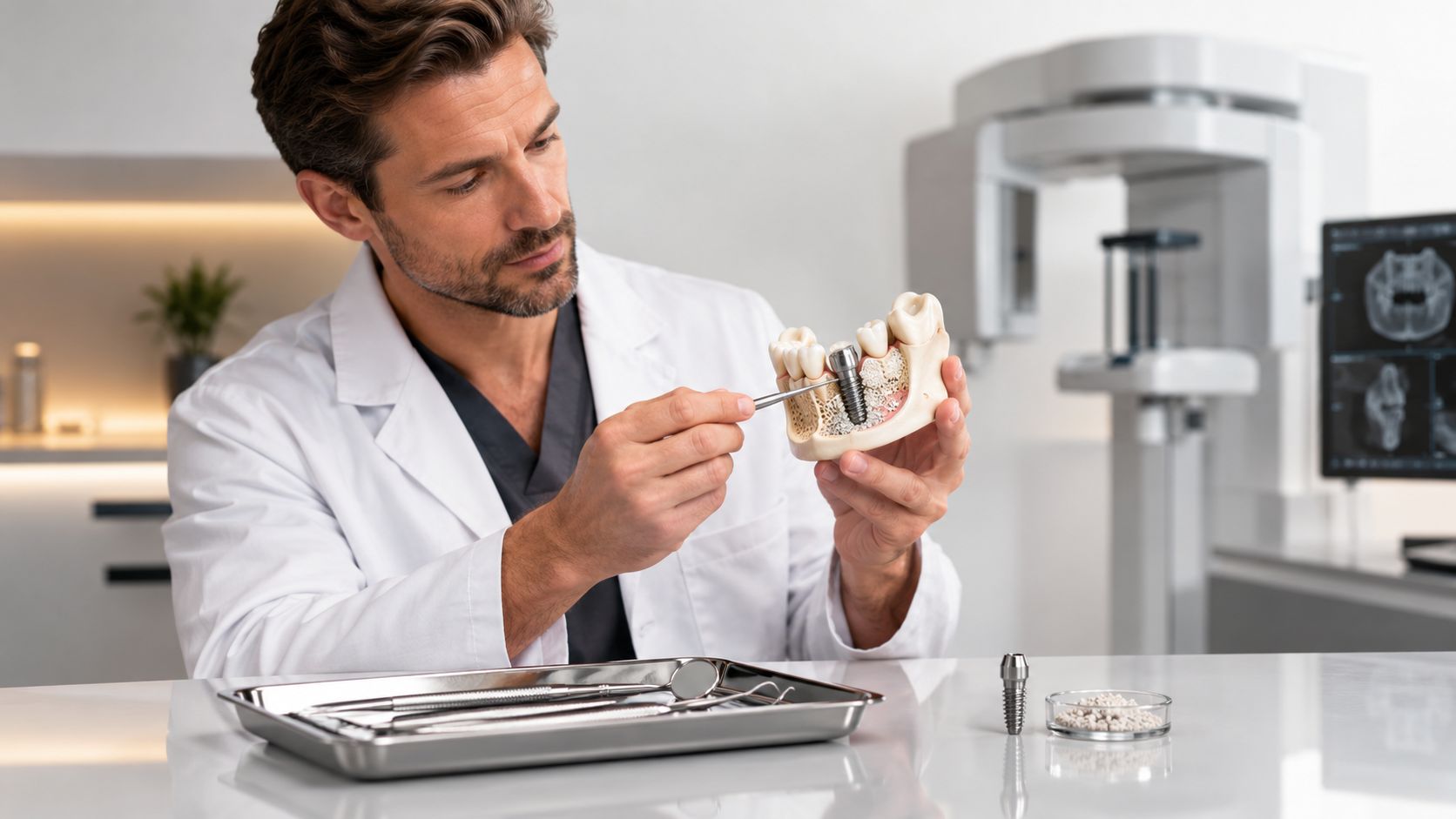
An implant replaces a missing tooth from the root upward. The structure includes a post placed in the jawbone, an abutment that connects the post to the restoration, and a visible crown that restores the chewing surface. The implant is therefore a surgical and restorative treatment, not a cosmetic covering.
The simplest chairside distinction is this: veneers restore a face, while implants replace a foundation. Cleveland Clinic's overview of prosthodontic treatment options also separates veneers, crowns, bridges, and implants according to whether they improve an existing tooth or replace missing tooth structure. Patients who want a more detailed record-keeping perspective can also explore dentistry clinical documentation.
For a plain-language explanation of the cosmetic process, see how veneers work. The important point is that neither option is automatically superior. A veneer is often the better answer for a tooth worth preserving. An implant is often the better answer when there's no reliable tooth left to restore.
Side-by-Side at a Glance
The table below puts the key decision criteria first. Rows where both treatments can perform well are less decisive than rows where one treatment clearly matches the problem and the other does not.
Veneers vs Implants Decision Criteria Compared
| Criterion | Veneers | Implants |
|---|---|---|
| Existing tooth status | Requires an existing tooth with enough healthy structure to support bonding | Designed for a missing tooth or a tooth that cannot be predictably restored |
| Primary purpose | Improves visible color, shape, minor chips, and surface appearance | Replaces the root and visible tooth with a supported restoration |
| Jawbone requirement | Doesn't require an implant site in the jawbone | Requires sufficient bone and healthy surrounding tissues for predictable treatment |
| Treatment character | Cosmetic and tooth-preserving, although preparation may be permanent | Surgical and restorative, with healing before the final crown |
| Bite forces | Works best when clenching and grinding are controlled | Also requires bite analysis because excessive forces can affect the implant and crown |
| Timeline | Generally a shorter cosmetic process with little recovery | Requires surgical placement, healing, and later restoration |
| Maintenance | Cleaning, gum monitoring, bite protection, and attention to bonding or ceramic damage | Cleaning around the implant, gum monitoring, restorative checks, and attention to bone health |
| Aesthetic ceiling | Strong option for changing the appearance of existing front teeth | Strong option for replacing a missing tooth while matching neighboring teeth |
| Main limitation | Doesn't replace a missing tooth or correct active disease | Doesn't make sense as a substitute for a healthy tooth that could be preserved |
| Future planning | The veneer may eventually need repair or replacement while the natural tooth remains | The implant, abutment, and crown can have different maintenance or repair needs |
The best option isn't the one with the most impressive marketing language. It's the one that fits the biological problem. A cosmetic dentist near me can assess enamel, tooth vitality, cracks, decay, and bite forces. A Dental implants near me search should lead to an evaluation that also examines bone, gum health, medical history, and long-term maintenance.
How Each Procedure Works Step by Step
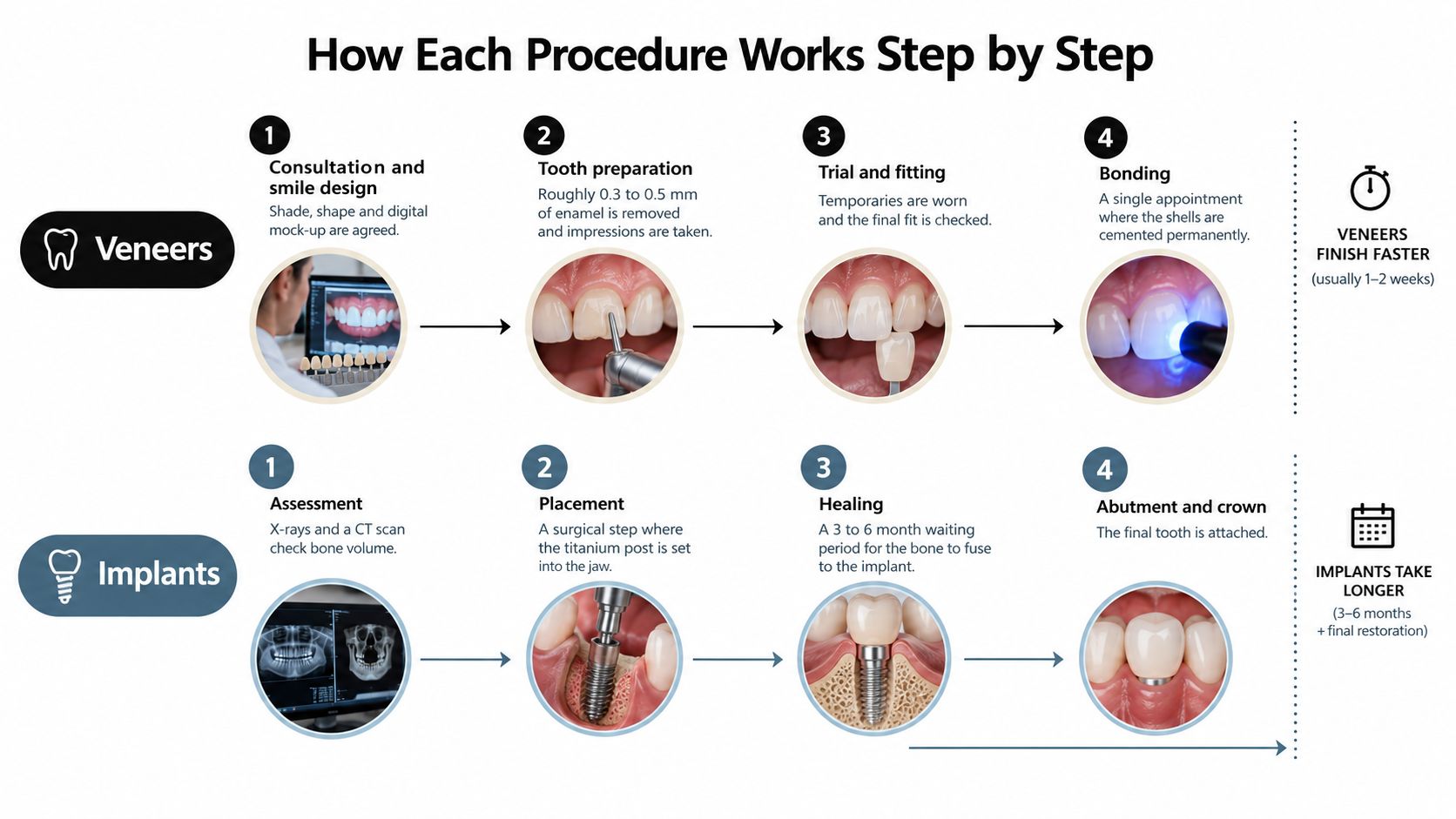
Veneer treatment usually begins with an examination, photographs, shade discussion, and smile design. Your dentist evaluates the tooth's enamel, gumline, bite, and underlying health before deciding whether a veneer is appropriate. If the tooth needs a filling, root canal, periodontal care, or another restorative procedure, that issue comes before the cosmetic work.
During preparation, the dentist removes only the amount of enamel needed to create room for the restoration and takes records for the laboratory or digital design process. A temporary restoration may protect the tooth while the final veneer is made. At the fitting appointment, the dentist checks the color, shape, margins, and bite before bonding the veneer securely.
Implant treatment starts with dental X-rays or three-dimensional imaging to assess bone volume, nearby structures, and the planned position of the replacement tooth. If the tooth is still present but cannot be saved, tooth extraction may be part of the treatment plan. The implant post is then placed into the jaw under local anesthesia, with sedation available for patients who need additional comfort.
Healing follows placement. Once the implant has integrated sufficiently with the bone, the abutment and custom crown are fitted. The final restoration must be evaluated for appearance, chewing function, cleanability, and bite balance. Treatment can take substantially longer than veneers because the body needs time to heal around the implant.
Your comfort plan matters. Local anesthetic is used for dental procedures, and some patients choose sedation because they feel anxious about injections, drilling, or surgery. A practice serving Cleveland and Chattanooga should explain expected chair time, temporary teeth, eating instructions, and recovery before you commit.
Longevity, Maintenance, and the Long Game
A restoration can remain useful for years without being maintenance-free. That distinction is central to the veneers or implants decision.
A systematic review of porcelain laminate veneers found an estimated 95.5% survival after ten years, based on 12 clinical studies involving 6,500 veneers. The same review counted fracture, debonding, secondary caries, and endodontic treatment as failures, showing why survival doesn't mean every veneer remains untouched or complication-free. See the systematic review of porcelain laminate veneers for the full clinical context.
Implant results are also strong, but the implant and the visible crown are different components. A review of implants supporting single crowns estimated implant survival at 97.2% after five years and 95.2% after ten years, while the crowns themselves had estimated survival of 96.3% after five years and 89.4% after ten years. The longitudinal implant review explains why an integrated implant can remain in the jaw while its crown later needs repair or replacement.
Veneers vs Implants 10-Year Outcomes Compared
| Metric | Porcelain Veneers | Dental Implants |
|---|---|---|
| Ten-year survival | Estimated cumulative survival of 95.5% | Implant-level survival estimated at 95.2% for single-crown implants in one review |
| What can fail | Fracture, debonding, secondary caries, or treatment involving the tooth nerve | Implant, abutment, screw, crown, surrounding gum, or supporting bone |
| Daily focus | Gentle cleaning, gum health, bite protection, and avoiding damaging habits | Cleaning around the crown and gumline, supportive maintenance, and monitoring for inflammation |
| Long-term reality | The veneer may need replacement even when the natural tooth remains | The implant may survive while the crown or another component needs attention |
Implants also need a failure plan. A 2025 systematic review of peri-implantitis treatment reported disease resolution in 58.6% of cases, progressive bone-loss arrestment in 69.6%, retreatment in 27.2%, and implant survival after treatment in 88.6%. The review is available through long-term peri-implantitis treatment evidence.
Bleeding, pus, gum recession, mobility, or persistent discomfort around an implant deserves prompt attention. Veneers need attention too, particularly if you clench, grind, develop decay, or notice changes at the gumline. The right question isn't whether treatment lasts forever. It's who will monitor it, repair it, and explain the next option when the restoration changes.
Cost, Value, and Lifetime Investment
A single treatment price can hide the financial commitment. For veneers, ask whether the estimate includes examination, photographs, design, preparation, temporaries, laboratory work, bonding, and future repairs. For implants, ask whether it includes imaging, extraction, the surgical phase, the abutment, the crown, sedation, and any treatment needed to improve bone or gum health.
No responsible dentist should quote a universal Cleveland or Chattanooga price without examining you. The number depends on the tooth, material, complexity, health of the surrounding tissues, and whether additional restorative or periodontal work comes first.
30-Year Lifetime Cost Comparison
| Cost component | Porcelain Veneers | Dental Implants |
|---|---|---|
| Initial evaluation | Cosmetic examination, photographs, bite assessment, and design planning | Structural examination, dental X-rays or three-dimensional imaging, and medical-history review |
| Preparatory care | Decay treatment, gum care, bite management, or replacement of an unsuitable restoration | Tooth extraction, gum treatment, or bone development when clinically necessary |
| Main restoration | Custom porcelain veneer and bonding appointment | Implant post, abutment, and custom crown |
| Comfort and temporary care | Possible temporary restoration and sedation if selected | Surgical comfort options, temporary tooth, and healing-phase care |
| Maintenance | Professional cleanings, gum checks, bite protection, and repair or replacement planning | Implant-specific cleaning, supportive maintenance, crown checks, and monitoring for inflammation or bone loss |
| Later investment | A veneer can need repair or replacement while the natural tooth remains | A crown or other component can need repair or replacement while the implant remains integrated |
| Best value measure | Conservative treatment that preserves a healthy tooth and meets the cosmetic goal | Predictable replacement of a missing or unsalvageable tooth without sacrificing healthy neighbors |
A bridge may be more appropriate in some cases, while a removable prosthesis may be preferable when surgery, bone support, health, or budget makes an implant unsuitable. The value question is broader than appearance. It includes durability, cleanability, chewing function, protection of neighboring teeth, and the likely burden of retreatment.
Ask for a written plan with separate fees for each phase. That makes it easier to compare options without confusing a low initial quote with a low lifetime cost.
Which Option Matches Your Situation
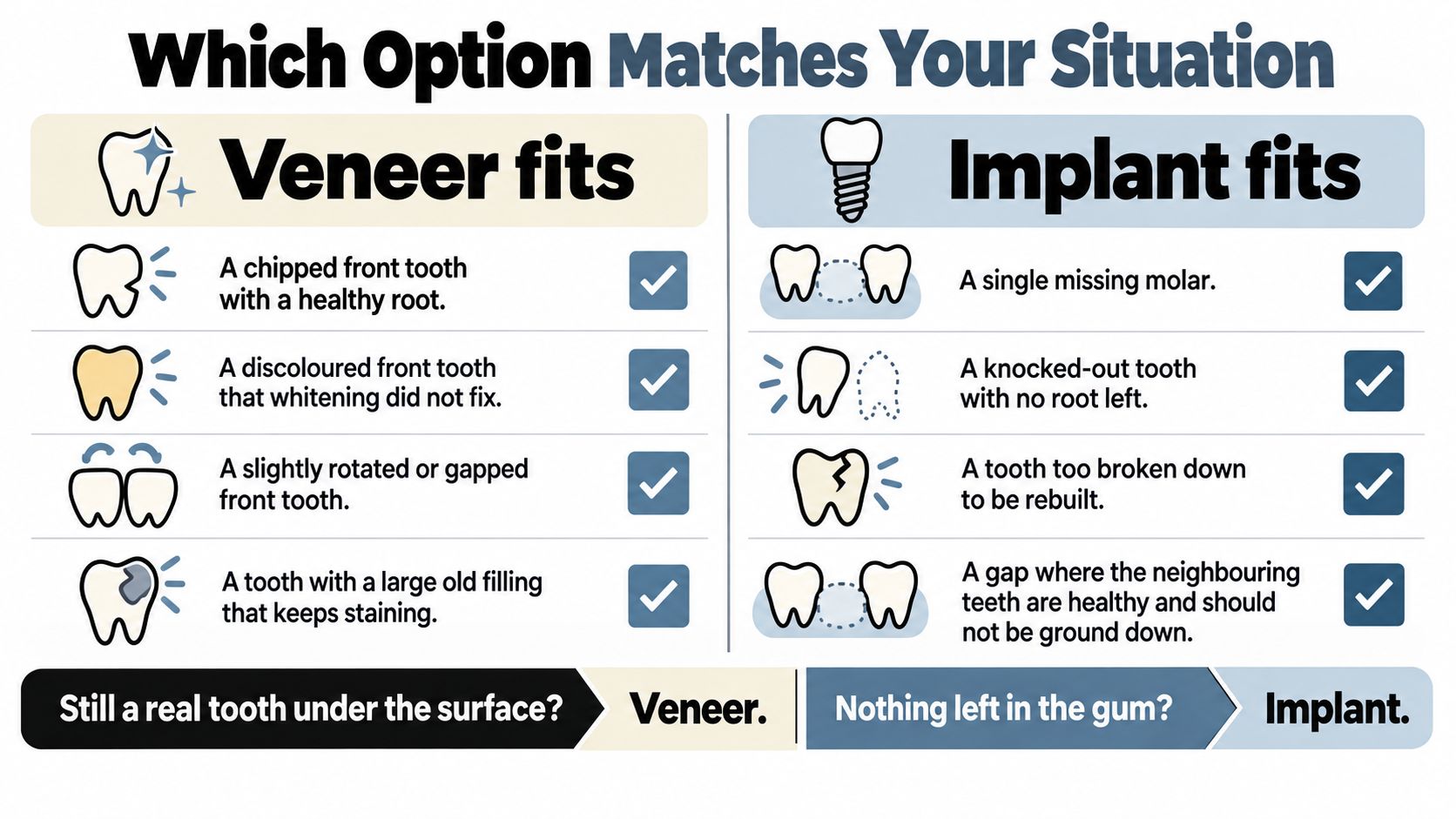
A chipped front tooth with a healthy root usually points toward a veneer evaluation, not an implant. The dentist still needs to rule out cracks, decay, nerve damage, weak enamel, and bite problems, but removing a treatable tooth just to place an implant is usually the wrong direction.
A discolored tooth that didn't respond to whitening may also be a veneer candidate if the tooth is structurally sound. Veneers can change visible color and shape, but they won't treat active decay or an unhealthy nerve. A tooth with significant internal damage may need restorative treatment instead.
A missing molar, a tooth lost after decay, or a tooth that is too broken down to rebuild points toward implant planning. If neighboring teeth are healthy, an implant can replace the missing tooth without requiring those teeth to serve as bridge supports. Bone and gum evaluation still determines whether implant placement is appropriate.
Veneer fits
- Healthy tooth underneath: The root and remaining structure can support a bonded cosmetic restoration.
- Cosmetic discoloration: Whitening hasn't achieved the desired appearance, and disease has been ruled out.
- Minor shape concern: A small chip, gap, or uneven edge affects the smile but not the tooth's ability to function.
- Controlled bite: Clenching or grinding can be addressed with protective treatment and a realistic design.
Implant fits
- Tooth is missing: There's no reliable natural crown and root to preserve.
- Tooth cannot be rebuilt: Decay, fracture, or structural loss makes long-term restoration unpredictable.
- Neighboring teeth are healthy: Replacing the gap without preparing those teeth is a priority.
- Chewing function is affected: The missing tooth has changed how you eat or distribute bite pressure.
Patients with gum disease, bone loss, smoking habits, poorly controlled diabetes, or heavy grinding need a more careful implant assessment. Guidance from Leeds Teaching Hospitals on dental implant risks identifies these factors as relevant to late implant failure. They don't automatically rule out implants, but they do make disease control and maintenance essential.
A full smile plan can combine veneers and implants when some teeth are missing and others need cosmetic improvement. The treatments should be coordinated so the color, proportions, bite, and gumline work together. For a clearer framework, review how shared decision making works, then discuss your specific risks and priorities with your dentist. Patients considering implant treatment can also review dental implant candidacy.
Your Next Step Toward the Right Smile
Book a consultation that evaluates both appearance and structure. A useful appointment should include a health history, dental examination, appropriate imaging, gum assessment, bite analysis, and a discussion of whether the tooth can be preserved. If both veneers and implants are reasonable, ask for separate written plans rather than a single bundled recommendation.
Bring the questions that matter beyond the first smile:
- Who will manage complications if the restoration develops a problem?
- What would repair involve if the veneer chips or the implant crown loosens?
- Could gum disease, bone loss, or grinding change the recommendation?
- What maintenance visits and home-care tools will be needed?
- What alternatives should be considered, including a bridge or removable prosthesis?
- Which part of the treatment is cosmetic, and which part is necessary for function or health?
Implant outcomes vary with bone quality, gum health, smoking, grinding, cleaning, and medical factors. Cambridge University Hospitals reports implant success of approximately 80% to 95% over 15 years in patients with healthy mouths, while its guidance reports approximately 80% to 85% over seven years in patients with gum disease. The Cambridge implant guidance supports a personalized prognosis rather than a one-size-fits-all promise.
If dental anxiety is part of the decision, ask about local anesthetic, sedation, comfort measures, and recovery instructions before scheduling treatment. You can also use practical self-care resources such as Luno: Self Care, but personal wellness tools don't replace an examination, imaging, or professional dental care.
For patients in Cleveland, Chattanooga, and nearby communities, Winn Smiles offers cosmetic evaluations, dental implant consultations, restorative care, emergency dental services, and comfort-focused treatment planning. The right answer between veneers or implants should protect your health, fit your budget, and give you a clear maintenance plan, not pressure you into the most extensive procedure.
Schedule a consultation with Winn Smiles to compare veneers and dental implants after your teeth, gums, bite, and bone have been properly evaluated. Whether you need cosmetic dentistry, tooth replacement, tooth extraction planning, or an emergency dentist in Cleveland or Chattanooga, the team can help you understand your options and choose the next step with confidence.