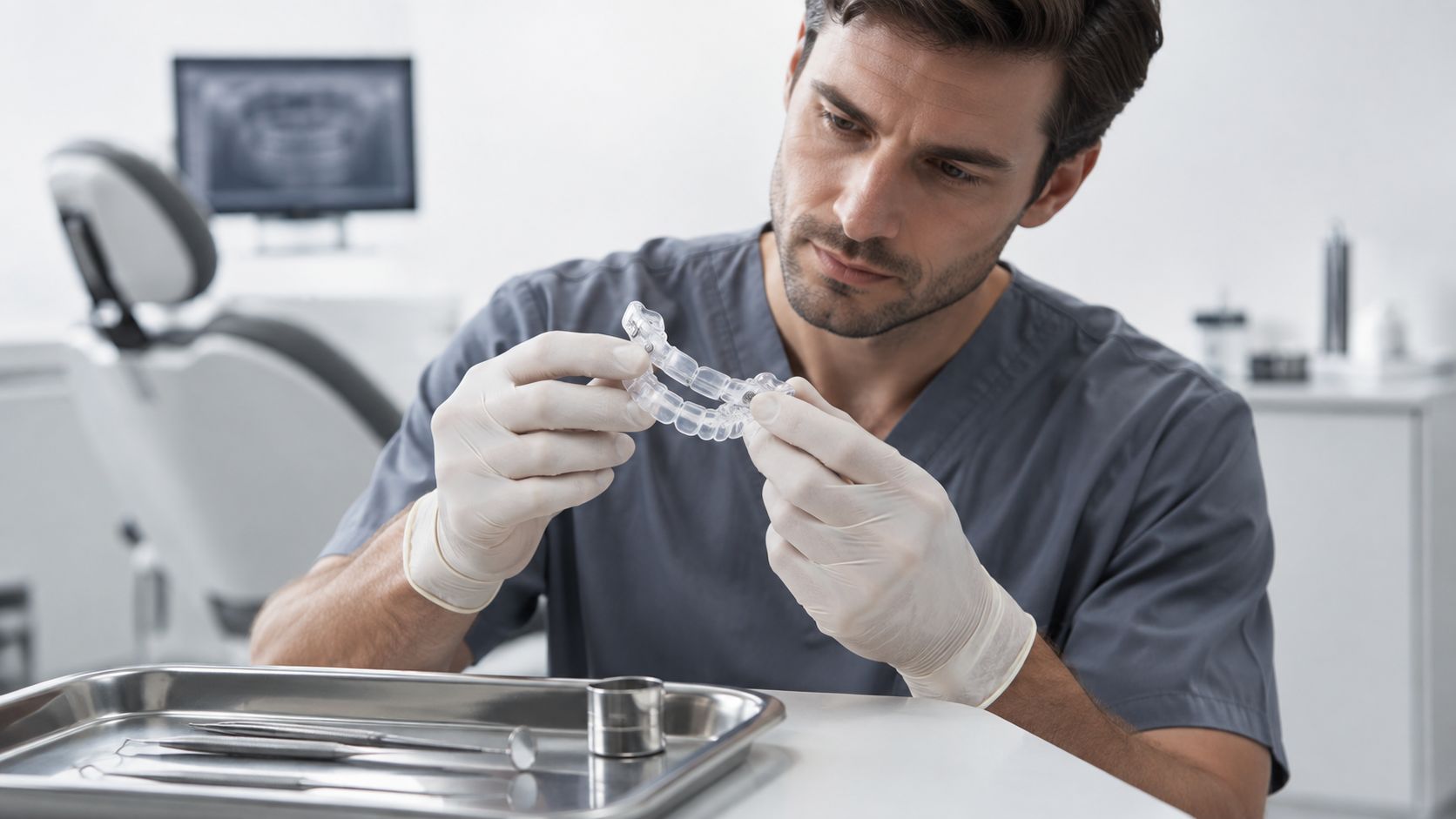
A sleep apnea oral appliance is a custom-made dental device worn during sleep that gently holds the lower jaw forward to keep the airway open, offering a CPAP alternative for obstructive sleep apnea. Clinical evidence has reported a 65.8% treatment success rate with a mandibular advancement device, while another review found custom devices reduced the apnea-hypopnea index by 30% to 72%, although results vary from person to person (clinical review).
Maybe you're waking with a dry mouth, loud snoring, morning headaches, or the uneasy feeling that sleep never refreshes you. Your partner may be the one who notices the pauses in breathing, while you notice daytime fatigue, poor concentration, or irritability. If you live in Cleveland, Chattanooga, or a nearby Tennessee community, Winn Smiles can help you understand whether dental sleep medicine fits your diagnosis and your daily routine.
Understanding Oral Appliances for Sleep Apnea
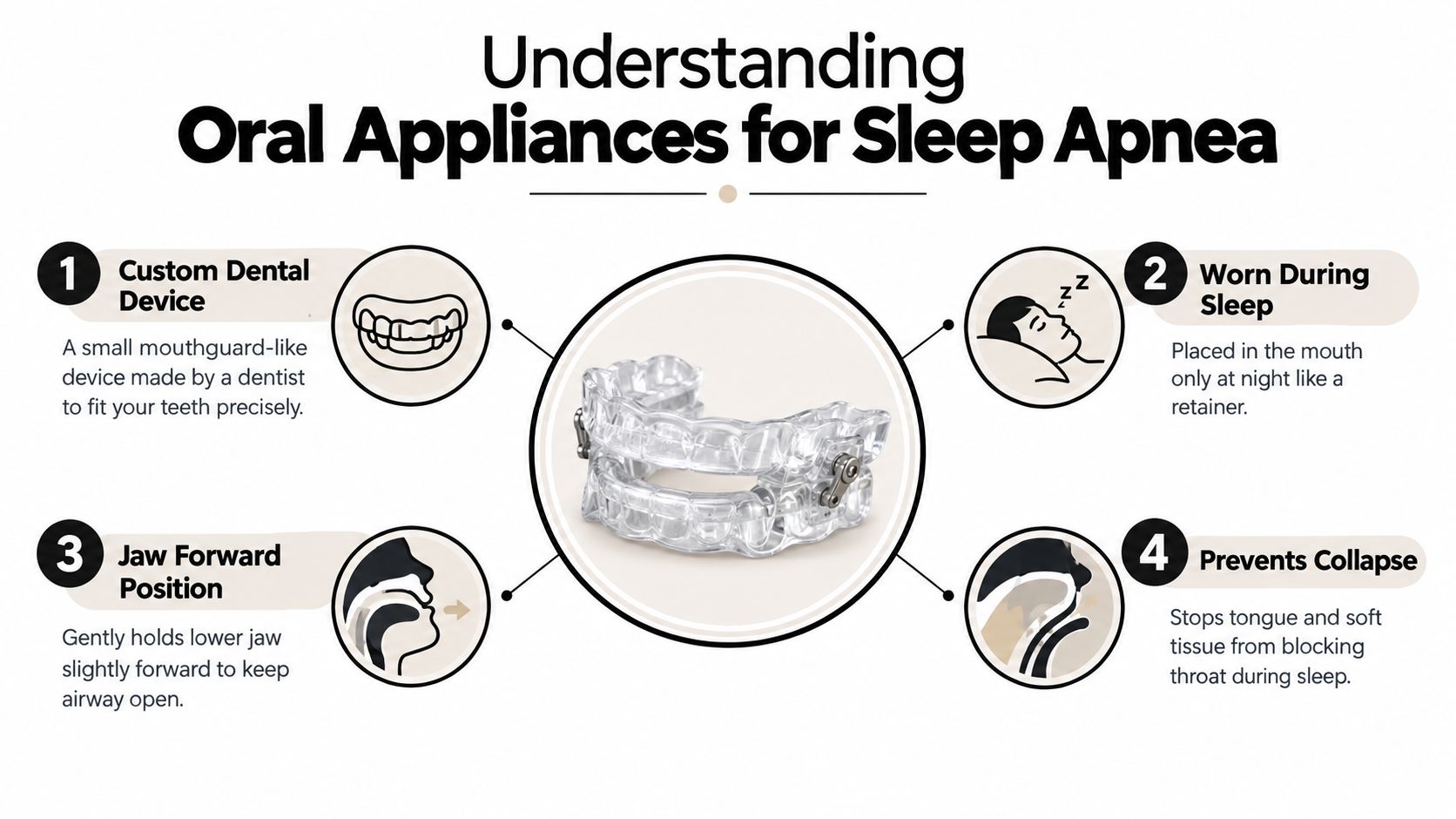
An oral appliance for sleep apnea looks somewhat like a mouthguard, but it serves a very different purpose. It's a custom dental device made to fit your teeth and worn only while you sleep. The most common design is a mandibular advancement device, or MAD, which gently positions the lower jaw forward so the tongue and nearby soft tissues are less likely to fall backward and block the throat.
That distinction matters. A pharmacy boil-and-bite guard is generally made to protect teeth from grinding or cushion the mouth during sports. A sleep apnea appliance is designed around your bite, jaw movement, airway needs, and medical diagnosis. The American Academy of Sleep Medicine and the American Academy of Dental Sleep Medicine recognize oral appliance therapy as an evidence-based treatment for adults with obstructive sleep apnea who can't tolerate CPAP or prefer an alternative. Their joint guideline recommends a custom, titratable appliance provided by a qualified dentist, while CPAP remains the first-line treatment when it offers stronger control of breathing (AASM and AADSM clinical guideline).
The two main device types
Mandibular advancement devices hold the lower jaw forward with connected upper and lower trays. They're the most commonly used oral appliances because they use the teeth and jaw to enlarge the space behind the tongue.
Tongue-stabilizing devices hold the tongue forward without advancing the jaw. They may be considered in selected situations, but a dentist must determine whether the design is suitable for your teeth, gums, bite, and airway.
At Winn Smiles, the evaluation begins with your experience, not just a device. The team reviews snoring, daytime fatigue, previous sleep studies, CPAP history, jaw comfort, and dental health for patients seeking care in Cleveland and Chattanooga. If you're still learning the basics, the practice's explanation of what sleep apnea is can help connect nighttime breathing problems with daytime symptoms.
How an Oral Appliance Opens the Airway During Sleep
Your throat behaves a little like a soft garden hose. When the surrounding tissues relax during sleep, the passage can narrow or kink. A mandibular advancement device gently brings the lower jaw forward, which also moves connected structures, including the tongue and hyoid-related tissues, away from the back of the throat.
This isn't just a way to make snoring quieter. Imaging and physiologic research shows that mandibular advancement can change airway geometry, particularly around the velopharynx, the area behind the soft palate. The device can increase the airway's side-to-side dimensions, reduce collapsibility, and help stabilize the tongue and hyoid complex (airway mechanism review).

What the adjustment feels like
The appliance doesn't shove your jaw into one fixed, extreme position. Your dentist starts with a controlled setting and adjusts it gradually, based on comfort, symptoms, partner observations, and follow-up testing. This process is called titration, and it means fine-tuning the device rather than assuming the first setting will be perfect.
CPAP works differently. It uses pressurized air delivered through a mask to help splint the airway open. An oral appliance uses a physical change in jaw and soft-tissue position instead. Both approaches aim to reduce obstructive breathing events, but they fit different bodies, sleep habits, and preferences.
For readers comparing devices and wondering whether a mouthpiece may help with noisy breathing, this overview of the best mouthguard for snoring offers useful background. Snoring alone still needs proper evaluation because it can occur with or without obstructive sleep apnea.
You can also watch the following visual explanation of the airway mechanics:
Who Makes a Good Candidate for Oral Appliance Therapy
The clearest candidates are adults diagnosed with mild to moderate obstructive sleep apnea, particularly those who can't use CPAP comfortably or prefer a smaller, less visible option. An appliance may also appeal to people who travel often, feel claustrophobic in a mask, have nasal obstruction, or struggle with mask leaks around facial hair.
Your sleep position and overall anatomy matter too. People whose breathing problems occur mainly while sleeping on their backs may respond well to an approach that keeps the jaw forward during those periods. A dentist also considers your bite, jaw range of motion, teeth, gums, and ability to support the appliance comfortably.
Severe sleep apnea deserves a careful answer
Severe OSA isn't automatically a simple “no.” CPAP generally remains more effective for normalizing the apnea-hypopnea index and oxygen saturation, but newer guidance describes custom, titratable oral appliances as a possible alternative when PAP treatment fails, isn't feasible, or is refused in selected patients (2025 to 2026 sleep disorder guidance). The decision depends on the device, your anatomy, the severity and pattern of your breathing events, and whether the treatment goal is complete normalization or a therapy you can consistently wear.
A 2015 guideline synthesis of 6 randomized controlled trials involving 399 adults found oral appliances lowered the oxygen desaturation index by a mean 12.77 events per hour (guideline evidence review). That supports measurable physiologic benefit, but it doesn't mean every appliance works equally well for every severe case.
Important safety point: Central sleep apnea, significant jaw-joint dysfunction, uncontrolled periodontal disease, and active dental decay require medical or dental attention before an appliance is considered.
Winn Smiles can review your sleep study and dental condition in Cleveland or Chattanooga, then explain whether oral appliance therapy is reasonable, whether CPAP should remain the primary treatment, or whether coordinated care with your sleep physician is needed.
Oral Appliance vs CPAP for Sleep Apnea
CPAP usually has the stronger effect in a controlled sleep study. A major review reported a mean AHI reduction of 13.60 events per hour versus control, while also finding that about one-third of patients achieved complete response, one-third achieved at least a 50% reduction, and one-third experienced minimal improvement with oral appliance therapy (major treatment review). The same review confirms that CPAP is generally more effective for normalizing breathing and oxygen levels.
The practical question, however, is whether you'll use the treatment consistently. A small appliance may be easier to pack for a work trip from Chattanooga, less disruptive to a bed partner, and simpler to put on when you're tired. CPAP can provide powerful airway support, but some patients dislike the mask, hose, noise, dryness, or bedside equipment.
Oral Appliance vs CPAP real-world comparison
| Factor | Oral Appliance | CPAP |
|---|---|---|
| How it works | Advances the lower jaw to help keep the airway open | Uses pressurized air through a mask |
| Comfort | Small, quiet, and worn inside the mouth | May feel bulky or restrictive at first |
| Travel | Fits in a compact protective case | Requires the machine, tubing, mask, and power accessories |
| Partner impact | No motor noise | Mask and machine noise may affect the bed partner |
| Maintenance | Rinse, brush, dry, and store properly | Clean the mask, tubing, humidifier components, and filters |
| Main trade-off | May cause jaw soreness, tooth tenderness, or bite changes | May cause dryness, mask discomfort, leaks, or abandonment |
| Clinical strength | Helpful for selected patients, with variable response | Generally more effective per hour worn for controlling OSA |
Oral appliance therapy still requires dental screening and follow-up. It may not provide enough control for every patient, especially when breathing problems are extensive or the jaw and teeth can't support advancement. CPAP may be the better fit for someone who tolerates it well and needs the most reliable airway support.
The right choice is the one that accounts for your sleep study and your real life. A therapy left unused on a nightstand can't help your breathing, regardless of how effective it is in a laboratory.
The Fitting Process and Custom Device Options
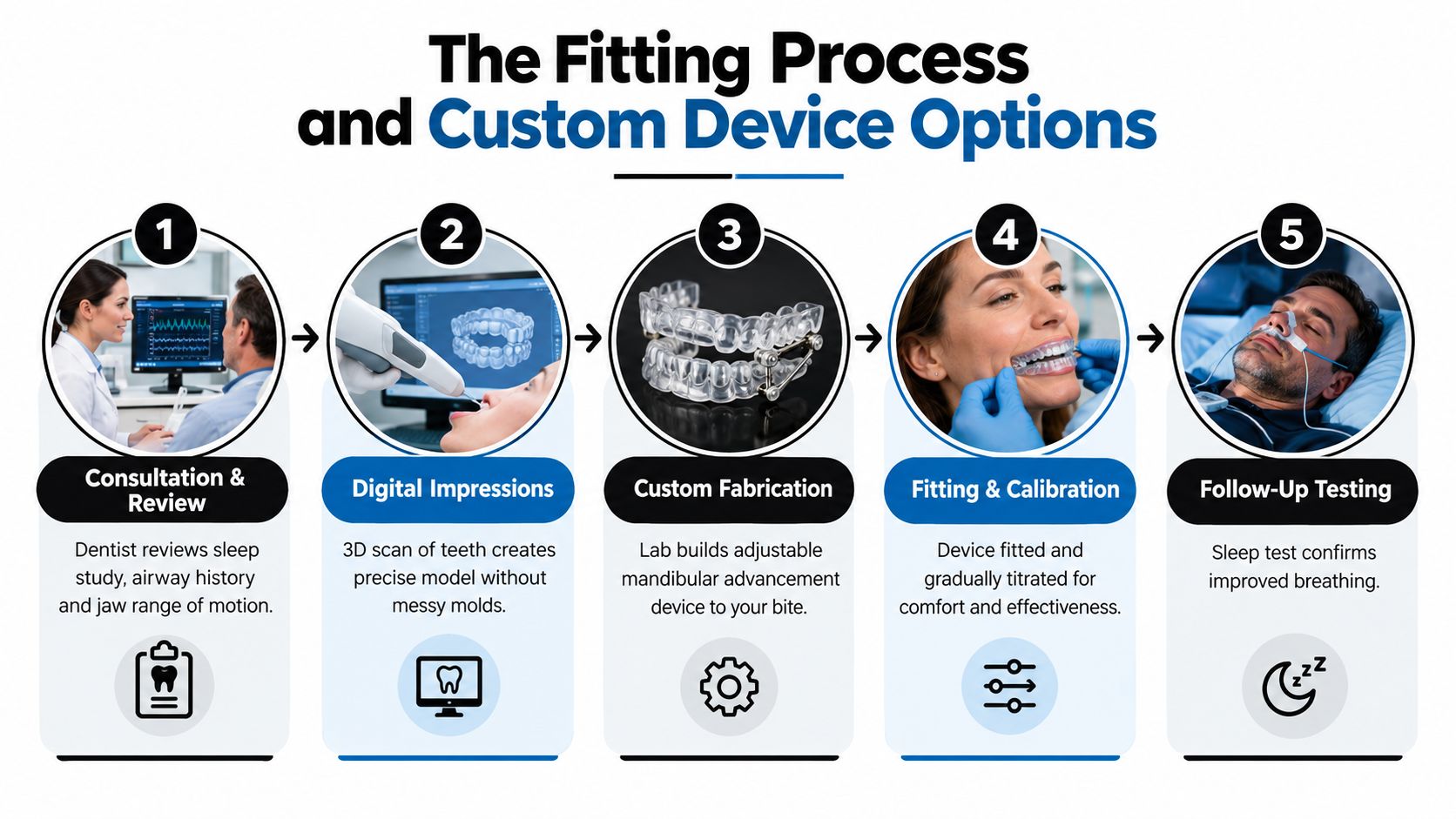
A proper appliance begins with both a sleep diagnosis and a dental evaluation. During the consultation, the dentist reviews your sleep study, airway history, symptoms, jaw range of motion, bite, teeth, and gum health. This confirms that the problem is obstructive and that your mouth can safely support the device.
The dental office then captures the shape of both arches with digital impressions or conventional molds. A bite registration records the jaw position used to design the appliance. The dental laboratory uses that information to fabricate an adjustable mandibular advancement device from medical-grade materials.
From delivery to titration
At the delivery visit, the dentist checks whether the trays seat securely without uncomfortable pressure. You'll learn how to insert, remove, clean, and store the appliance. The starting jaw position should be controlled, not needlessly aggressive.
Follow-up visits allow gradual advancement based on comfort and breathing results. If symptoms continue, the dentist may adjust the device incrementally and coordinate follow-up sleep testing with your physician or sleep specialist. For more detail about different designs, Winn Smiles provides information about types of oral appliances for sleep apnea.
| Device option | Custom appliance fitted by a dentist | Over-the-counter boil-and-bite guard |
|---|---|---|
| Fit | Made for your teeth and bite | Generic fit shaped at home |
| Jaw control | Designed for controlled, adjustable advancement | Position may be imprecise |
| Monitoring | Includes dental checks and titration | No built-in professional follow-up |
| Comfort | Adjusted when pressure or rubbing occurs | May feel bulky or unstable |
| Long-term concerns | Fit and bite can be monitored | Poor fit may make discomfort or bite changes more likely |
A store-bought mouthpiece may look affordable and convenient, but it isn't a substitute for diagnosis, prescription, fitting, or confirmation that your breathing has improved.
Side Effects, Adjustments, and Daily Care
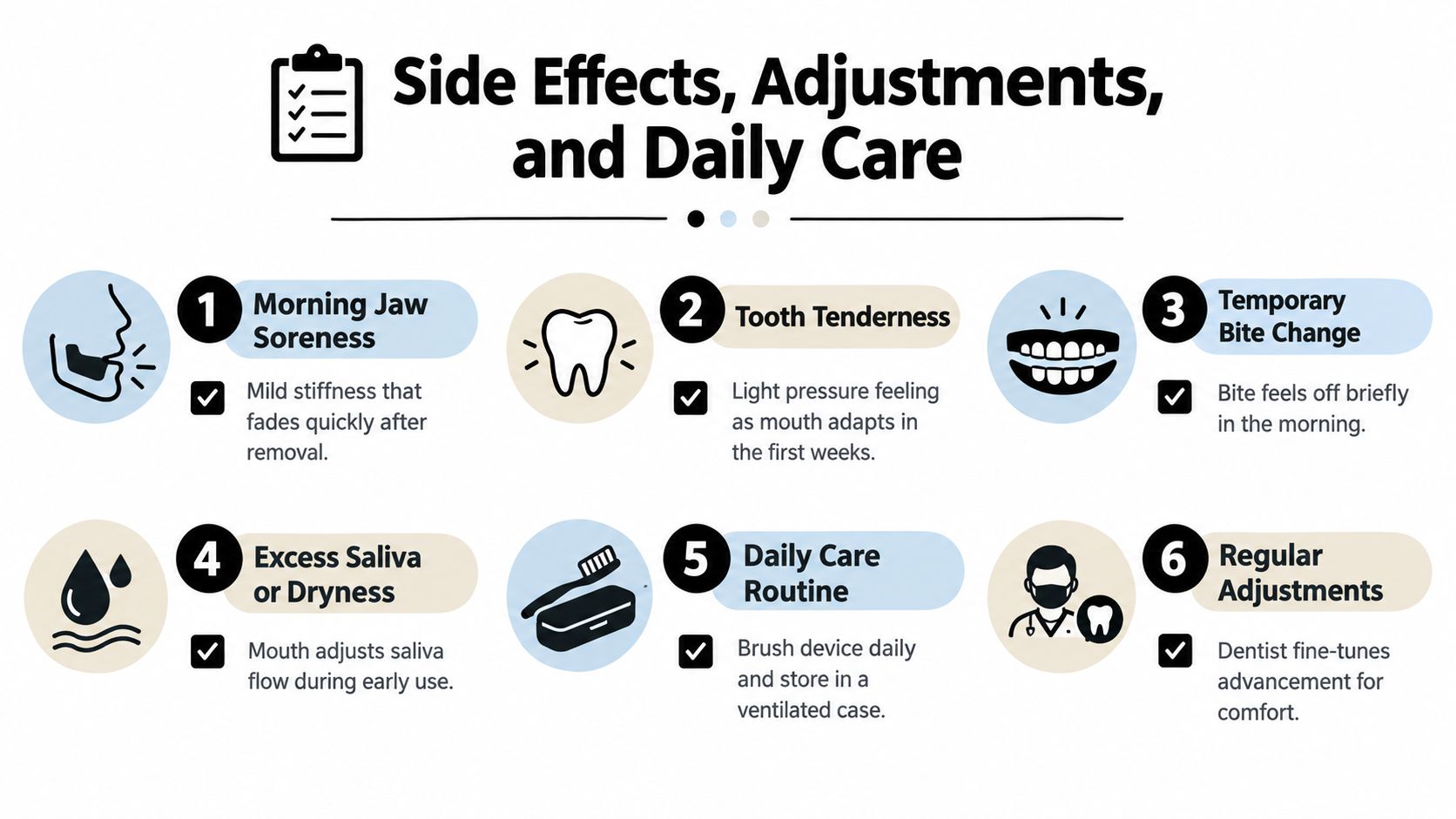
Most early complaints involve the jaw, teeth, saliva, or morning bite. You may notice jaw stiffness when you remove the device, mild tooth tenderness from overnight pressure, or a temporary sense that your bite feels different after waking. Some people produce more saliva, while others notice dryness. A temporomandibular joint flare-up is uncommon but should be reported promptly.
These symptoms don't automatically mean the treatment has failed. Small fit or advancement adjustments, gradual acclimation, and brief morning jaw stretches often make the appliance easier to tolerate. Your dentist should know if discomfort persists, intensifies, or affects chewing during the day.
A simple care routine
Rinse the appliance when you remove it. Brush it gently with a soft toothbrush and a non-abrasive cleanser, then let it air dry on the counter before placing it in a ventilated case. Avoid hot water and heat, which can distort the material.
A denture or appliance-cleaning tablet can provide a deeper weekly clean. Bring the device to every dental checkup so the Winn Smiles team can inspect wear, confirm that the fit remains stable, and look for changes in your bite or supporting teeth.
Practical rule: Your appliance is part of your treatment, not a disposable accessory. Clean it every day and bring it to appointments.
Regular dental care matters for successful therapy. Cleaning and exams, dental x-rays when appropriate, periodontal treatment, restorative dentistry, tooth extraction, or dental implants may need to happen before or during sleep apnea treatment if your teeth and gums can't support the appliance.
What to Expect at Winn Smiles in Cleveland and Chattanooga
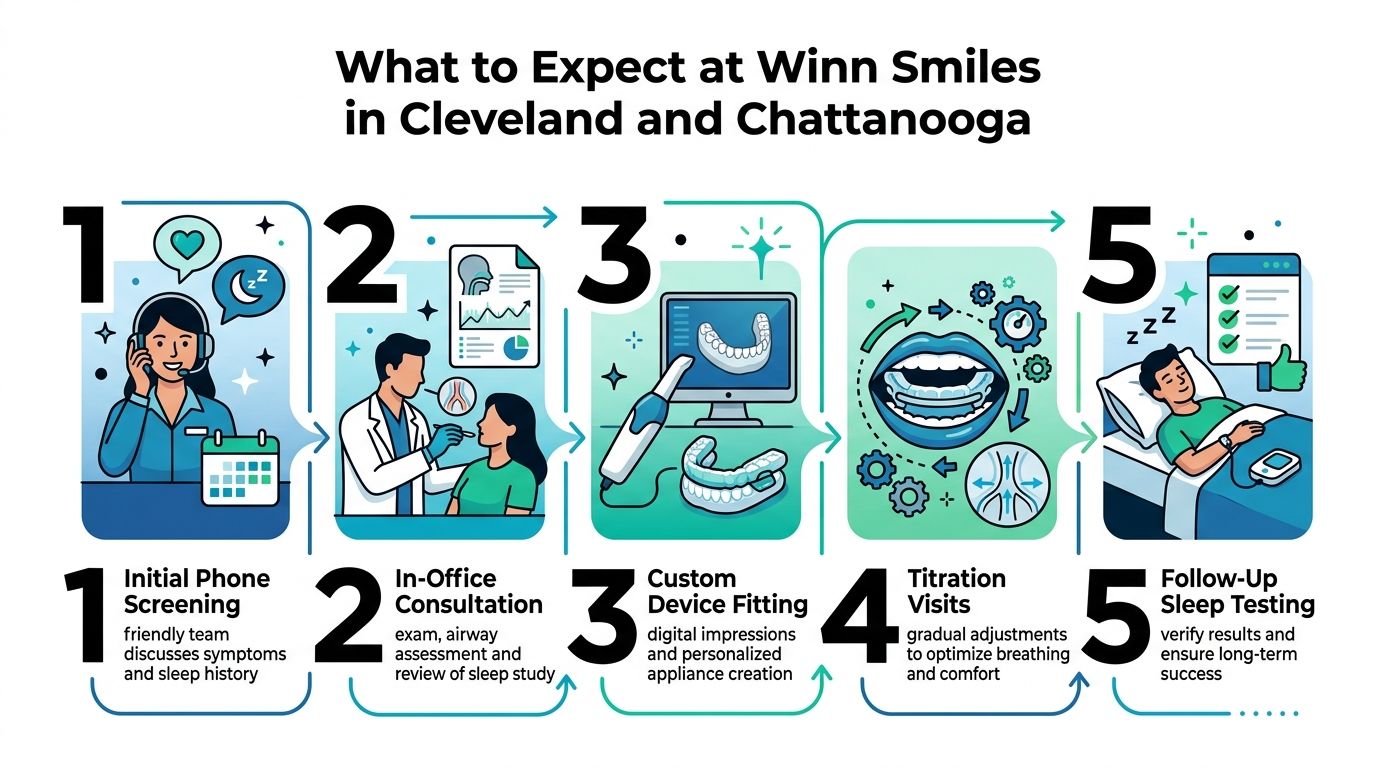
Your first step is a screening conversation. The team asks about loud snoring, witnessed breathing pauses, waking headaches, unrefreshing sleep, daytime fatigue, prior sleep testing, and any experience with CPAP. Bring your sleep study results, prescription information, medication list, and questions about comfort or insurance.
At the in-office consultation, the dentist examines your teeth, gums, bite, jaw movement, and airway. The team explains what the findings mean in everyday language before recommending a device. If decay, gum disease, jaw pain, or unstable dental work could affect treatment, those concerns are addressed as part of the plan.
A coordinated care pathway
If you're a candidate, digital impressions or molds record your teeth and bite for custom fabrication. At the fitting appointment, the device is checked for comfort and the jaw position is calibrated. Later titration visits help refine advancement rather than leaving you to troubleshoot an uncomfortable mouthpiece alone.
Winn Smiles coordinates with your physician or sleep specialist when needed, especially when a sleep study must be reviewed or follow-up testing is appropriate. A home sleep test can help confirm whether the appliance is improving breathing, not merely reducing snoring.
Patients in Cleveland and Chattanooga can also discuss related dental needs during the evaluation. Preventive exams, periodontal care, restorative dentistry, emergency dental services, cosmetic dentistry, same-day crowns, and dental implants may all be relevant when oral health affects appliance fit or overall treatment planning.
Taking the Next Step Toward Better Sleep
An oral appliance for sleep apnea is a custom-made dental device worn during sleep. By gently holding the lower jaw forward, it helps keep the airway open and offers a practical CPAP alternative for selected adults with obstructive sleep apnea.
Mild to moderate OSA remains the clearest setting for treatment, but severe cases shouldn't be dismissed with a blanket answer. Selected patients may still be considered when CPAP fails, can't be used, or is refused, with careful medical coordination and follow-up testing. The quality of the fit, the adjustment process, the condition of your teeth and jaw, and consistent nightly care all influence whether the therapy works for you.
If you're researching broader wellness assessments alongside sleep concerns, you may also want to review these executive health testing options. For sleep apnea itself, start with a diagnosis and a personalized dental and airway evaluation rather than choosing an unregulated mouthpiece online.
Residents of Cleveland, Chattanooga, and nearby communities who snore loudly, wake unrefreshed, or already have an obstructive sleep apnea diagnosis can schedule a consultation with Winn Smiles to discuss oral appliance therapy and other dental needs. Book your appointment with Winn Smiles to find out whether a custom device fits your breathing, bite, and lifestyle.
Winn Smiles offers evaluations, custom sleep apnea oral appliance therapy, fitting, adjustments, and follow-up coordination for patients in Cleveland and Chattanooga. Visit Winn Smiles to request a consultation and take the next step toward a treatment plan that supports better sleep.